Thursday, 20 July 2006

LITTLE MISS SUNSHINE—The Evening Class Interview With Valerie Faris and Jonathan Dayton


Little Miss Sunshine is a thoroughly enjoyable laugh outloud kind of movie. I came out of the screening energized and enthused, as did most of my colleagues, and my day felt a little more chipper for having seen it. It was clear to me why this road movie about the dysfunctional Hoovers was a Sundance darling and why Fox Searchlight bid ten million for distribution rights. What I didn't expect was that some critics were up in arms about audiences feeling good about Little Miss Sunshine, moreorless insinuating that they just didn't know any better, a very tired trope that still packs some clout in certain circles. Or perhaps, I should say, in certain squares. Because there are many kinds of artistry and providing enjoyable entertainment is, in my book, one of them.

My thanks to Shelley Spicer of Terry Hines & Associates who arranged for a roundtable discussion with myself, Omar Moore of PopcornReel.com, and the husband-wife directors of Little Miss Sunshine—Valerie Faris and Jonathan Dayton. We all hooked up at the Ritz Carlton for a breakfast session. Valerie and Jonathan have that endearing Altmanesque quality of overlapping and finishing each others' sentences. Maybe I should just call it marriage?

Omar Moore started things off by stating the characters portrayed in Little Miss Sunshine are wonderfully real people, with whom it's easy to identify for all their faults and foibles. Particularly impressive for Omar was Frank (Steve Carell) whose arc transforms him from suicidal ideation towards an eventual acceptance of life.

"I think our interest—even going way back to when we started doing documentaries—has always been in character and people," Valerie explained. Even in their music videos, it was the personalities of the bands they worked with that interested Faris and Dayton. That's why the film appealed to them. It had six interesting characters and they related to each one of them as real people. "When we met with Steve Carell, we didn't know he could do this based upon what he had done. But when we met with him and talked to him about the character, the tone of the movie and the way we were approaching it, he was right on the same page with us." They wanted to respect the characters, to not laugh at them and to journey with them. It was important to make the Hoovers feel like a real family with history, and that the film was merely a glimpse at a three-day period in their lives; lives that extended past this three-day period. So they worked in rehearsals on developing relationships between the family members and building a sense of their common past. That's part of what made them so real. In Carrel's case, he was an amazing actor who loved his part and his character. He was smart and funny, Valerie described, without needing to be funny all the time.

Jonathan added that there were many factors that led to all the good performances in the movie. Certainly, it began with Michael Arndt's writing. "Michael, to his credit," Jonathan explained, "writes characters who have longings that reach beyond the immediate needs of the story." Some characters feel like they're existing solely to serve the needs of the immediate story and they don't really dream beyond what's happening in the now." Whereas in Little Miss Sunshine all six characters have giant lifelong dreams. That's something you immediately identify with because, of course, hopefully everyone has those dreams in their lives. "The characters become more universal because of that," Jonathan continued. Carell was excited about stretching out. He had shot Forty-Year Old Virgin, which wasn't out yet, and that had certainly been a big step for him. Little Miss Sunshine was yet another jump into true drama. There are moments Carell has in the film that are plainly not humorous and, thereby, challenging. Jonathan was glad that all the actors were there to support Carell. "We were certainly interested in creating an environment where he could do that."

What impressed me as a self-identified gay male was the portrayal of Frank as a conflicted human being like everyone else in his family. There wasn't any need for any kind of kneejerk politicization of his character. His universality came across not because of his gayness but because of his humanity. I commended Valerie and Jonathan for presenting him that way. Steve's performance, along with the performances of the entire ensemble, were perfectly poised. I asked how they had achieved that egalitarian parity among the ensemble?

Valerie responded that what they loved about Little Miss Sunshine was precisely that it was a true ensemble piece. "There really isn't a protagonist," she pointed out. "If there is one it's Olive, the little girl. Most of the scenes have all six characters in them and that's what drew us into it. We get to create this sense of a family in an ensemble, and the way they then are able to work together as actors instead of each person separately doing their lines, doing their scene. Each scene you see them, they're interacting. Those scenes were played in long pieces so that they could really develop at their own rhythm. Maybe that's why it has a sense of reality because it's their real timing. It's not created and stylized. It's real time pacing." By example, the dinner scene is one of the longer dinner scenes in any film. I quipped, "Chicken again!!" and we all laughed.

Jonathan filmed "five million takes" so the actors could sink into character and begin "boxing with their fellow actors."

"If we could create what feels like real life in these five-minute scenes," Valerie offered, "it's more like we're just shooting a documentary. We kept thinking let's try to make this family feel like we're just following them. That there's actually something happening between the characters instead of each shot you're trying to create something. So much of it was really happening between the characters. Frank is an interesting character. We thought of the dinner scene from his point of view. He's the outsider coming into this family and it's the last place he really wants to be. But he's taking it all in. He hasn't spent much time there so, for the first time, he's sort of, 'Oh my God, this is my sister's existence.' Immediately he's probably one of the first characters you identify with in watching the film. There aren't that many movies where you identify with a gay suicidal Proust scholar."

"Exactly," I concurred.

"That's what's so great about the writing," Valerie stressed, "is that somebody could hear 'gay suicidal Proust scholar' and think, 'How can I relate to that character?' " But you do, partly because of who Steve is and all the warmth he brings to the role. "The story allows you to enter these very different experiences in different people. I always felt completely drawn into them. It wasn't like you're watching them from a distance. I always felt they were very easy characters to identify with. I don't know if that's going to be true for everybody."

"We'll see," Jonathan smiled.

Omar noted that Richard Hoover, the father character played by Greg Kinnear, wanted the best for his family. He had idealistic hopes for his children and sometimes, of course, things didn't go according to plan. "How much do you think what you've done in terms of that idea of trying to provide for a family resembles something like It's A Wonderful Life?" Omar asked. To what extent did other films influence Little Miss Sunshine? Because when he saw the movie he sensed its Capra-esque qualities.

Jonathan remembered being influenced by Capra's films as a child. "We all look to film to tell us about the rules of life," he said. "Certainly, in America we're taught that if you work hard and play by the rules, you'll be rewarded. What was interesting about this film is you have these guys who are trying their best to do what is expected of them and it may not pan out for them. We thought this family was an interesting modern middle-class family because—even though they have a house and the two cars—they're actually teetering on the edge of financial disaster."

Valerie ran with his thought. "You can have the house, you can have the car, but it's always at risk." Another thing that appealed to them about this story was the struggle of this average family. "It is so hard to keep a family together and actually do something." As ridiculous as Richard's pursuit of his self-improvement program is, he's trying so hard and ultimately there's some sort of payoff in that he does keep pushing the family and keeps them chaperoning Olive to her dream. The fact that they do make it to California redeems Richard. To celebrate the effort as well as the end result was important to the directors. "We devalue experience and only value achievements and results," Valerie complained. "We liked that it was really about the experience. That's what they gained."

"This is a film that compares two value systems," Richard added. "Looking at life as a contest versus looking at life as a dance." The first words in the script are when Richard says, "There are two kinds of people in this world: winners and losers." Through the course of Little Miss Sunshine, the Hoovers' adventures teach them to see life more as a dance, where they can find joy, and prevent others from judging them by not subjecting themselves to judgment.

Valerie agreed. "So many people feel like they're put to this test constantly. We're such a winner-oriented society. America has to be the number one super power. There's this oppressive attitude and it's liberating to take charge and enjoy your life." She stressed how important it was not to devalue what you have. Including relying on family, I mentioned.

"It's funny," Jonathan commented, "because you hear so much about family values and we told the cast, 'This is really about the value of family.' Which is a very different thing. Hopefully there's true power in seeing people who actually love each other." Even though they're so different from each other, Valerie interjected. "Beneath the arguments there's something that endures," Jonathan insisted.

But Valerie maintained that all families are not that way. Some are rotten and they hate each other and there's good reason. She cautioned against making general statements. "Our experience," she said, "has been that [family] is the place where you can be at your worst. There are very few places where you can go at your lowest point. Frank, where does he end up? He ends up with family. There are no friends rescuing him from the hospital; it's his family. It was great to see him go from judging all the characters at the dinner table to actually totally being part of that family."

Since the character of Richard had been brought up, and cognizant of their background in music videos, I expressed my respect for their selection of music in Little Miss Sunshine, particularly the scene where Richard is on the motorcycle on his way to "make things right" with La Llorona playing in the background. Valerie was surprised I knew the song. What self-respecting Chicano wouldn't know La Llorona? I asked how they chose their music.

"It was very important for us to find the right sound for this movie," Jonathan asserted, "We hoped that we could find it before we actually filmed the picture because that's how we worked for years and we've found that music informs our choices." Valerie concurred they were inspired by music. Who they discovered was a band out of Colorado named Devotchka who have a hybrid sound between Latin and East European music. The four members of the band play multiple instruments, including tuba and trumpets.

"We heard them and we just said, 'Oh my God. This is the sound.' " Jonathan recalled. "We wanted to have music up front and really use it for all it can give and, at the same time, we didn't want to use it as a crutch. Today so often you'll see a scene and they'll bring in a pop song with a lyric line that will tell you—as if you don't know—what you're supposed to feel." They didn't want that. "We cut the whole film without any music, just letting the rhythms of the scenes find their place and then when that felt right to us it was thrilling to then bring in these songs."

La Llorona was on Devotchka's album and, as Valerie described it, they found the song "perfectly bittersweet", both sad and hilarious, with a "sense of perseverance." The music, Jonathan furthered, had a "vibration of all these different qualities. It's not just Sad Sack. Hopefully what's fun about this material and these performances is that they aren't a single note, they're chords, they have these other things going simultaneously."

Omar returned to the idea of a dance in life versus a results-oriented mentality, which made him consider the road itself as a metaphorical process, not only in how it furthered the script but how it influenced the actors' performances.


The metaphor of the van that's on the verge of breaking down on the journey was a conscious metaphor of the Hoover family. "The van was a little bit like a test tube or a petrie dish," Valerie explained, and the actors were put into this hot, noisy, shaking vehicle. It was important for them to shoot all of the car scenes on the road, no green screen, no studio versions of people driving in a car. So it was uncomfortable and necessarily rough on the actors. Most of the time all six of them were in the van together. "You're on a freeway and you can only shoot in one direction so the light doesn't change. You shoot one way, then you have to turn around, then shoot again. It's not comfortable and fun but they still loved each other. These guys got along great. They still had fun. They went through the miserable experience together." Jonathan suggested it helped the actors bond and Valerie agreed, adding that the scenes were shot in sequence so that the van ride came after the dinner scene. "You started to feel certain tensions building between Richard and Frank. It was very easy to tap into the frustration and anger because it was a tough shoot. The experience of being in the van together and shooting that way helped support what was going on in the story."

I asked if they anticipated the response they got at Sundance and how they reacted when they received the $10 million bid from Fox Searchlight. Jonathan said they weren't expecting anything at all. They were too busy finishing the film, which was accomplished on a Wednesday before the premiere on Friday. Though they had screened it for friends and had looked at it in its entirety, the sound wasn't finished. The Sundance screening was their first time in front of a real audience and the first time they literally saw it end to end.

"You're partly just fearing, 'Oh God, is something going to be missing? Is the sound going to drop out here?' " Valerie confessed.

Sundance was the perfect place to introduce the film, Jonathan recalled, because it's an incredibly warm, receptive, interested audience. That was amazing enough in itself but then they were so happy when they sold to Fox Searchlight because, first of all, "they seem to really love our movie [and] seem to understand how to market films like this. They're doing a lot of word-of-mouth screenings, which is really our preference, to just let this be a word-of-mouth phenomenon, not something that's heavily marketed and sold. I really like being considered an indie underdog film. We're kind of teetering on the edge because—let's be frank—it was made for very little money. It was made like an indie film but we have big stars."

Valerie added, "The fact that Steve Carell is in it did—all of a sudden—focus a lot of attention on it. Even before we got to Sundance there was interest in the movie just because he was in it." They had spent so long trying to get the movie made that they never expected the Sundance reception. It had been so hard to convince people that the film was worth shooting. The idea that it would be so well-received never crossed their minds. They just wanted it to be done and were amazed that they got it done and were happy with it. That was as far as they could imagine anything.

Returning to Omar's description of the film as Capra-esque, I brought up the complaint some critics have that the movie is derivative. They were both well-aware of that critique. "Personally," I qualified, "in the audience I was in, they were laughing so uproariously and my reaction was, 'What's wrong with going to a movie and enjoying a movie? Who cares if it's a story that's been told before if the retelling still works?' " What distinguishes Little Miss Sunshine for me was the direction, the writing, and the ensemble performance. I asked how they felt about the criticism that Little Miss Sunshine was "derivative"?

"What isn't derivative?" Jonathan countered. "I think it's derivative of my life!" Valerie laughed. "It's more derivative of my life than films we have watched. We love film but we're not film scholars." And Jonathan insisted they were not interested in quoting other movies or other filmmakers that they love. Valerie added, "We love Capra and what it is we love about him is he did make movies about the common man—mostly men, but, y'know, we can change that maybe. I love that about him but I don't have any desire to quote [him]. We certainly weren't looking at other road movies and saying, 'How can we update this form?' We were more interested in the story of the family and how it felt like our lives. It's funny, but, maybe it's accidental there are things that seem like references to other movies."

Jonathan acknowledged that there are other movies like National Lampoon's Vacation, which they haven't seen. But he was happy to hear my reaction because, truth be told, they welcome criticism and people examining the movie and opening it up, but if people start getting into this game of comparing the film with certain plot lines, then they've really lost. My reaction is exactly what he hopes people will have, which is that they'll be moved, that they'll have an emotional cathartic experience. He hopes they'll look at that aspect of the film and not become too caught up in some kind of game of charting resemblances to other films.

Valerie summarized, "If you're not going with the film, if you're just going to sit back and watch it for those things, you can criticize it all you want. You can't expect to win everybody over. I'm just thrilled that some people go with the film and enjoy it and go for the ride. That's really what you hope. If you let yourself do that, I think it's a pretty fun ride. But not everyone likes rides."

Dealing with reactions has been a new experience for them. Jonathan enjoys looking at blogs, finds them fun to read. "With the online world now you can really get instant feedback." Valerie doesn't go there so much and lets Jonathan tell her what he's read.

"I'm glad to hear that," I told them "because this year is the year where a tension has kind of been created between print press and what's being called the 'citizen press corps.' When you said the word-of-mouth thing, I thought, 'Yes, this is what's going to make this movie work.' Maybe the critics have seen too many movies and they want to find something derivative but word-of-mouth is going to sell this movie." Valerie could only hope that would be true.

Omar was curious about what transitional challenges the couple had shifting from their work in commercials and music videos to filming their first full-length feature.

"The biggest challenge for us was to create living scenes in the film," Jonathan answered. "In music video and commercials it's storytelling by frame where you draw your storyboard and you cage your actors and their stories in that frame. You have 30 seconds to tell that story or three minutes to tell that story and you have to use a shorthand in commercials that may not always be lifelike or true to life but you need to compress. But in the film we really decided that our frontier was going to be to get great performances and to create a lifelike environment."

Valerie explained that they wanted to create that lifelike environment in front of them through the interaction of the actors and not just through the lens. "If it's happening in the room, if they're interacting and there's something really happening there, you can pretty much put your camera anywhere. We had very specific places we wanted the camera. But you can't create it just in your shot. It has to be happening. With an ensemble film, you have to create the life between the characters."

"So it was more about staging," Jonathan replied. "Also, we're really into movement. You can get so involved in the camera movement and the actors are all just standing there doing their lines. So what we did, we really worked ourselves. We staged the movie. We staged scenes from the movie for years prior to actually shooting. It took five years to make so within that time we workshoped. We decided not to wait. We decided to explore these scenes. We had a chance to see how to stage the scene where the woman comes in and tells them that they can't take the body, they have to fill all these forms, we did those scenes and we started to understand how they worked so that when we went to shoot them, we had a greater knowledge."

"The difference is we had three and a half years of prep on this movie," Valerie added. "Commercials and videos, you do it in a month and you're done. We lived with these characters. We lived with this story. We didn't put it down. We kept it alive for ourselves because we believed in it. We believed it would happen even though it was really discouraging at times. The fact that they became a part of our lives, it's almost as if we were part of this family. The time you spend with something makes the process of actually making the film so much easier. It felt very organic to finally get to bring it to life."

I asked how the story came to them, did Michael Arndt bring it to them?

"He wrote it as a specs script," Valerie answered, "and he gave it to these producers Ron Yerxa and Albert Berger who produced Election. Michael had met them when they were doing Election. So he asked for the script to be sent to them and they'd been giving us scripts for years so they gave us the script. I credit them because I don't know if somebody could look at our past work—the videos and commercials—and say, 'Oh yes, this is a perfect match.' They knew us well enough to know that we would respond to this material. I don't know how we got it, there were 14 other directors, but we just liked it so much. We went in absolutely determined and not willing to let them give it to anybody else. We're passionate about it and passion is worth something. It is so important to be that passionate about something when you do it because it's a lot of work and it's so rewarding when you really love it. So we're hoping that will happen the next time."

Omar enquired about their working process since they're both directors on the set. "Does either one of you do something more particular than the other? Are there one group of tasks that one does versus another? Because the actors are coming to you and they're seeing two directors. How does that work?"

"We both do everything," Jonathan replied, "and the key is to be prepared so we really do work out everything in advance. Having said that, there are always things that happen on the set that you don't expect and you're happy to fan those flames. A little exciting idea happens and you want to encourage it. Val and I in a way are like this idea incubator. Having the two of us as this kind of safe zone to talk about any idea, no matter how silly, allows us to entertain things that I know, myself, I would never speak openly on a set. But when you have someone that you trust and you can be vulnerable with, you can encourage ideas that otherwise would never see the light of day. Then when we talk with actors, we're very aware that this was a giant issue. That you couldn't in any way set up a situation where they would hear mixed messages. So typically after a take one of us would have a strong feeling and we'd discuss it and then that person would go and talk to the actors and then they would continue to talk to them throughout that scene."

"It's usually per scene," Valerie qualified. "I'll work with Greg on this one part of the scene. Jonathan will talk to Toni more on that scene. We kind of tag team but it's not consistent throughout the whole film, it's just scene by scene. It may be that he has a stronger feeling about something that we're looking for, that we're trying to get, and he may have a stronger feeling about how to get it from that actor or I may have a clearer way of expressing it to the actor. So we'll just talk and we're pretty much always about five inches apart and we're [she whispers in his ear] and then one of us will go and be the messenger. It's funny, but we're a lot like one director except that, hopefully, we have separate heads. We are sensitive to the fact that it's different for the actors but we never heard anybody even [complain]. They forgot about that. You just become an entity. We were a directing entity."

And part of the ensemble, I suggested. "Exactly," Jonathan agreed, "No, it really is that."

"And filmmaking crews are ensembles," Valerie offered, "If your crew is all in sync, if everyone's on the same page, you're always exchanging ideas with your DP, with your production designer, with your costume designer, it's a collaborative process, it's not dictatorial. I guess some people think that's what directors do. They stand there with a megaphone and tell everybody what to do. I would hate to direct that way. I love working with a group of people who are all invested, and all have ideas and all contribute. It's just an extension of that."

I brought up their choice of Abigail Breslin, who I consider the new guard after Dakota Fanning, and enquired how they found her.


Jonathan said, "When we got the job years and years ago, the very first thing we said is, 'Thank you and now we got to find Olive.' " They both realized there was no way they could make the film without the right actress in that role. Obviously they needed to find the right actors in all the other roles but if they didn't have Olive, they really wouldn't have a movie. And they knew it was not going to be easy because there were a lot of child actors out there who just don't have life, who to a certain effect aren't children anymore, they're mini-adults. Not unlike the contestants in the Little Miss Sunshine Beauty Pageant, I said, who I found scary.

"The first thing we were able to do was to get some seed money to start casting," Jonathan outlined, "and we worked with these two casting directors, Kim Davis and Justine Baddely, who had done all our videos, who had done many films as well, and they launched a worldwide search and they had representatives in every English-speaking country, in New Zealand, Australia, the United Kingdom, all over America, Canada, South Africa. We looked everywhere. They saw hundreds and hundreds of girls and they, thankfully, whittled it down for us. But really the only person that struck us as being right was Abby. We saw her when she was six and she was almost too young at the time. We continued to look but we kept an eye on her.

"What was it?" I asked, "What was it that you saw?"

"She's just got an intelligence," Valerie described. "She's very present. A lot of kids have trouble focusing for any length of time. Whoever she's acting with, she's really listening to them. She's a really good listener. Most kids they'll spit out their line and then they're gone. They zone out. And then, 'Oh, c'mon, your next line's coming' and then they'll spit that out. But she can play a six-minute scene, five-minute scene, and she's there for every line. And the way we saw that, you can see it just when she auditioned, she did the grandpa scene, you could see that she was in that moment. She's in the scene."

"She didn't overdo it," Jonathan furthered. "She was one of those people who actually was very plain. It wasn't like she was turning on the charm, 'Let me show you this.' There were no fireworks. She had the ability to be natural. We really credit her parents. Her mother was not a stage mother. When we met Abby and her mom, we were looking at the mom as much as her. You don't know what you're in for. We've done so many Gap Kids ads so we've seen every stage mom you can imagine. Kim, her mom, was as much a selling point as Abby."

"Abby's still a kid," Valerie added. "She interacted with all the little girls at the pageant. She got down and played with them. It wasn't like, 'I'm the star of the movie.' She was playing with them, teaching all the other girls her dance. She had a really good time with them and you could see they actually had a little kid in them still, but you never see it on film. Abby is a very level-headed little girl who has been brought up well. She doesn't act like a little star. She always came completely prepared. She knew her lines. Most kids in films you're prompting every single line."

At this stage we had to wrap up our roundtable, so after thanks and congratulations, I quickly asked, "Where can I get a 'Jesus Is Wrong' t-shirt?"

Cross-posted on Twitch.

Wednesday, 19 July 2006

EMETIC HORROR—Feed


Bruce Fletcher, programming director for San Francisco's Holehead, seemed as surprised as anyone that Brett Leonard's Feed ended up winning audience favorite this year. He booked it as his closing night film in hopes that it would send people fleeing from the Roxie Film Center in disgust but, instead, his San Franciscan audiences "ate it up." His job gets tougher every year.

I had already forewarned Bruce that I probably wouldn't watch Feed. I was too disturbed by the trailer and didn't think I could stomach not only its viscerality but its political incorrectness; but—with the endorsement of his Holehead audience—I figured it warranted the old college try so I watched it on screener at home. To my surprise, I was engaged by Feed. I can't say I enjoyed it, I can't say I didn't want to eat salads for a week, but I was definitely caught up in this "depraved little gem." It's surprisingly less visceral than you might expect; it's what it suggests that is most disturbing, more than what it actually shows.

You know the story: cyberporn investigator Philip Jackson (Patrick Thomas), freshly traumatized from busting cannibals in Germany, begins to suspect that an online sub-dom scene between Feeders and Gainers is being taken to criminal ends at FeederX, an American livecam website, where bets are being laid on missing women forcefed to death. The premise is improbable, of course, because any customers for such a website would have to pay by credit card and could easily be traced and the movie belabors the investigative hacking for dramatic effect, but, credibility aside, Feed is effective for all it sniggering triggers and boggling toggles. Leonard has a firm understanding of the hot buttons in the American psyche. As a thinly-guised indictment of American consumption patterns, Feed scores big, and perhaps even more emetically than Super Size Me or Fast Food Nation.

"What gives this film its truly creepy side is its blurring of the line between consent and abuse, as underscored in a subplot revealing Philip's own uncomfortable sex-life," Jonathan Trout writes for the BBC. True. There's more physical violence shown in the sex Philip has with his slutty girlfriend than anywhere else in Feed.

Alex O'Loughlin as Michael Carter is the perverted psychopath messed up by Mother who—despite the horrible things he is doing to Dierdre (comedienne Gabby Millgate in a complex, believable performance, let alone an astounding fat suit)—manages to come off sympathetic and, I hate to admit it, downright sexy. The contrast of his lithe, tattooed body against Dierdre's immense folds of flesh shortcircuits all notions of acceptable intercourse. But therein lies the rub, eh? Acceptability becomes the platform for perversion and horror. And the hero might end up being even more fucked up than his prey.

Whereas other horror flicks scare through startle shock tactics, Feed leaves a residue of discomfort and queasy unease. Give it a chance on dvd. You deserve to be disgusted and might even find a certain delight in being so.

Cross-posted on Twitch, where one of the readers commented that he was at the Holehead screening and that McDonald's cheeseburgers were tossed out into the audience before the film began! Talk about ODOR-ama!

2006 SFSFF—Bucking Broadway


First thing Saturday morning John Ford's Bucking Broadway with Harry Carey, Sr. was introduced by Joseph McBride, the author of many notable books on film history, including Searching For John Ford: A Life and Whatever Happened to Orson Welles? (due out this October).

McBride expressed his delight in having Harry Carey, Jr. present as a living emissary of the John Ford stock company and as the representative of a family that spans the entire history of American films. His father Harry Carey, Sr., the star of Bucking Broadway, was originally a D.W. Griffith actor, as was his mother, the wonderful Olive Carey. Harry Carey, Sr. was a big star in the silent era and he was John Ford's mentor and tutor in the early years; Ford learned an awful lot from him. Astoundingly, Bucking Broadway was made when John Ford was only 23 years old. He made nine films in 1917—the first year he directed—and Bucking Broadway was one of them. A lot of the early Ford-Carey westerns were lost and a few of them have gradually been rediscovered over the years so, for McBride, it was a treat to see one of them intact on 35mm. The print of Bucking Broadway was accidentally discovered in a French archive six years ago where it had been misfiled. Thus, McBride considered it "a real treasure." McBride claimed that—those unfamiliar with Harry Carey, Sr.—would be astounded by how natural an actor he is, way before the modern acting style had developed. He was just very easygoing, very natural. John Wayne modeled himself after Harry Carey, Sr. and said he was the greatest of all western actors.

I wasn't wild about Bucking Broadway, was expecting more, though I could appreciate its historicity. I was bothered by its portrayal of women as weak-minded and weak-willed, and its racist portrayal of Blacks. In one scene Cheyenne Harry (Harry Carey, Sr.) wants to impress his beau Helen (Molly Malone) and shops for a new suit. He tries on a series of suits that don't fit, either the sleeves are too long, or they're too short, but, finally he settles on one. He steps outside feeling the dandy and then discovers that there's a Black man wearing an identical suit bought at the same store. I could have accepted the broad humor of this had it been another cowboy wearing the same suit but for it to be a Black man indicated to me that it was so far beneath Cheyenne Harry to wear what a Black man would wear, such an insult, that he had to go back into the store and throw the suit in the proprieter's face.

After the screening of Bucking Broadway Harry Carey, Jr. joined Joseph McBride on stage. Carey had difficulty maneuvering the stairs and required assistance. When he finally sat down, he quipped, "That was about the worst entrance I've ever made." His humility immediately endeared him to his audience.

Highly recommending Harry Carey, Jr.'s book, Company of Heroes, McBride stated the chapter on Three Godfathers was so "hysterically funny" that he almost fell on the floor laughing. Further, he stated it was the best account of John Ford at work, and a clear, complex and intimate portrait suffused with deep understanding. McBride pointed out that Harry Carey, Jr. had been in nine John Ford films, including some of his greatest (such as The Searchers).

Harry Carey, Jr. conceded he had been in three really great westerns. "I guess I was just very very lucky," he said humbly. One was a non-Ford—Howard Hawks' Red River—and then She Wore A Yellow Ribbon and The Searchers. Three "pretty good" westerns.

It was strange for him to see his dad so young in Bucking Broadway. The film had been made in 1917, four years before his birth. For him it was amazing how much his grandson Alec resembles his dad. "He's a great looking guy, wasn't he?" Harry Carey said proudly of his father, initiating a round of applause.

Harry Carey, Sr. and John Ford were a great team. According to his mom—who was a great bright tough lady—the young John Ford and his father—who was about 18 or 19 years older than Ford—had a real fine relationship but, because of gossip between other actors, his dad and Jack Ford parted ways. The break wasn't that serious as far as friendship went; they still saw each other three or four times a year even after they stopped making movies together. Perhaps they could have gone on making even more films together but they made 20-some. Irritated, Harry Carey, Jr. claimed it was "so typical of Universal" not to take care of those Ford-Carey films, letting them rot away in a vault somewhere. Of the 26 movies that John Ford and Harry Carey, Sr. made together, only about 3-4 of the features and parts of several others have survived.

"What's amazing to me," McBride asserted, "is that it's a small fraction of what they made together but they're all completely different in terms of their storyline, their tone, they're not formula pictures at all even though they have genre elements, and they're very low-budget. I love the unpretentious quality of these films, they're just very easygoing and relaxed. You see Ford's great eye for composition in the very beginning of his career with those beautiful long shots and the depth of compositions, don't you?"

"Yeah, that's marvelous," Harry Carey, Jr. agreed, pointing out that Ford also loved his "action stuff." Watching the fight scene at the end of Bucking Broadway reminded Harry Carey, Jr. that Ford used to just let his actors go during those fight sequences. He didn't want to routine it, or block it out or rehearse it. He would say, "Fight" and that was it. Frequently on set you would walk up to somebody and they'd have a bloody nose or cut eye. Carey broke three ribs in one film and suspects it was Jack Ford who broke them while providing instructions. The way Ford staged his fights was to encourage a big free-for-all.

Ford was 21 years old when he directed Bucking Broadway which Carey considered a "terrific movie and a terrific western." He used to sit at the breakfast table with his father and a man named Joe Harris, who was in a lot of the old pictures. Joe ended up staying with the Careys at their ranch for years and years as a kind of foreman and gave up motion pictures. Harris was Harry Carey, Sr.'s closest friend. Over breakfast Harry Carey, Jr. would hear their stories about John Ford and the making of those westerns in the silent days. "I grew up listening to those stories so it's always a pleasure to see one of them."

"What did your father say about John Ford? What kind of memories did he have?" McBride asked. Harry Carey, Jr. responded that he would "start at the end and then go backwards." Because about a year before his father passed away, about 1946, Carey, Jr. said, "Pop, how come you don't work for Jack Ford anymore?" He thought his father would say, "Oh, I don't want to go through all that again and blah blah" but he didn't. He just said, "He won't ask me." That's all he said, "He won't ask me." He paused for a minute and then he predicted, "…but you will." He qualified, "Not til I croak"—that was the expression he used—"After I croak, you will." Of course, the day after his father passed away, Jack Ford cast him in Three Godfathers. "He knew him pretty good," Carey, Jr. praised his father and admitted, "If I had told that story to John Ford I would never have worked for him again." Three Godfathers begins with an affectionate dedication to Harry Carey, Sr: "To Harry Carey—Bright Star of the Early Western Sky."

Ford kept telling Carey, Jr. before they started shooting Three Godfathers, "You're going to hate me when the picture's over; but you're going to give a good performance." He kept saying, "You're going to hate me when the movie's over but you're going to give a good performance." "I didn't hate him after the film was over," Carey, Jr. emphasized, "I hated him after the first day! [Laughter.] It was a horrible experience! [More laughter.] If it wasn't for Duke—John Wayne—I would have gone home. I said, 'He doesn't like what I'm doing. I'm going to go home.' Duke said, 'No, he loves what you're doing.' To which Carey, Jr. responded, 'Well, how can he act like that and like what I'm doing?' And Duke insisted, 'He's doing it for a reason.' " Three Godfathers was his roughest role and, even though he went on to make nine or ten more films with Ford after that, Three Godfathers was his roughest, toughest experience.

McBride mentioned that his current favorite Ford film is Wagonmaster, a "perfect movie" in which Carey, Jr. had a part. "It's like those early films with your dad, it's very low budget, it's just a bunch of friends out in the beautiful wide open spaces." McBride wanted to know if Wagonmaster was a fun film to shoot?

"It was the most fun of all!" Carey, Jr. affirmed. Working for Jack Ford was like a vacation. Wagonmaster was the first film in Moab, Utah, a tiny town since grown big. They'd never had a movie location there. Wagonmaster was the first one. It only cost Ford about a half a million dollars to make the pic (which even for those days was a cheap-budget). But it was a charming little picture and one of John Ford's favorites, something he said all the time. In fact, he said it was his favorite a few times. But Ford made so many great films that it's hard to pick one out that is really better than any other. Wagonmaster had the distinction, however, of being the most fun Carey, Jr. had on a Ford set.

At this juncture McBride noted that Harry Carey, Jr. was called "Dobe" by his friends because his father named him that the day he was born. "Dobe" explained: "I had this bright red hair when I was born and my dad thought it was like that red adobe clay that was there on the ranch and we lay around in a house built out of adobe. He'd never say it was an adobe house, he'd say, 'It's a 'dobe house.' So he nicknamed me Dobe and I've been Dobe ever since. I thought about using Dobe as my regular motion picture name and people have always thought that it was Warner Brothers Studios that made me use Harry, Jr., but, actually it was my dad. When I got a part at Warner Brothers, the first part I had was in a picture called Pursuit with a very young Robert Mitchum. Dobe was 25 and Mitchum 27 or 28. He asked his dad whether to use Dobe or Harry, Jr. for his stage name and his father said, "I'd like you to use Harry, Jr. and carry on the name." Since that was his father's request, that's what he did, though his Mom was resentful of the choice. She wanted him to use the name Dobe. "Too bad, Mom," he apologized, "that's the way it is." Whenever John Ford introduced Dobe, he always referred to him as Harry Carey, Jr.

John Ford was present when Dobe was born. Ford and Dobe's father were getting drunk that day, May 16, 1921. "The same birthday as Henry Fonda and the same birthday as Liberace," Dobe stated to much laughter. "Yeah, that's quite a combo." Increased laughter.

From the audience Jim Kitses, author of Western History: Horizons West, asked if John Wayne was consciously emulating Harry Carey, Sr.'s gesture of holding his left bicep with his right hand at the end of The Searchers. It was a gesture that his dad did a lot in real life. He would stand and talk like that with his one arm crossed over his chest. "Duke was shooting the tag of The Searchers," Dobe answered, "and he looked to camera left or right—I can't remember which—and he saw my mother was right in his eyeline and that's what made him do that. He just went like that as a tribute to my dad. Every time I see that it really knocks me for a loop. It's a beautiful moment."

McBride quoted Ford as saying that Harry Carey, Sr. was a thinking actor and that you could see clear into his soul. His characteristic gesture was pensive.

"John Wayne was a terrific actor to work with," Dobe recalled. "When you're doing a scene with him, he'd give it everything. You could play off of him so well because he's a very honest actor and a very sincere actor, no phoniness, or making faces or stuff like that for Duke Wayne. He was always great doing scenes with. I remember—I think one of the last shows I did with John Wayne was called Big Jake and I played an older—I was only in my 40s at the time and I played an old man, a mean old guy with brown teeth and great big beard. I thought that he would object to my playing that role. And he [didn't], he was very supportive and it was something that I enjoyed doing very much. I was like 43-44 and played a guy in my 60s. So all the way to the end he was great to work with, all the way to the end."

McBride clarified that as Dobe became middle-aged, Ford continued casting him as a young guy. Yeah, Dobe smiled, "I'm 85 and I think he'd have me playing a guy 20 years old." He was always a kid to Jack Ford. One of the last great visits between John Ford and his father was out at John Ford home—a beautiful estate he bought for the guys in his outfit. There were 18 of the boys in his outfit who were killed in action and so it was a shrine to all of their memory. He dragged his father out there to go horseback riding and Ford showed up. He and his father sat beneath a tree and talked continuously for four hours, catching up on each other's lives. "It was wonderful to see," Dobe recalled, "It was not too long before my father passed away."

Harry Carey, Jr. was asked what the working relationship between John Wayne and Montgomery Clift was like in Red River?

"Not so hot," Carey, Jr. responded. Apparently, Wayne wasn't too fond of Monty Clift. Of course, Carey, Jr. didn't know that when he was working on Red River. Partly because he only worked on the film for three weeks and was only in a couple of scenes, though one really good scene with Wayne. "I would have been on that show for twelve weeks had I been cast in the beginning of it," he explained, "But what happened was we were up in a place called Elgin, Arizona, right outside of Tuscon, they were shooting there and the young man who was playing the part of Dan Latimer said that he was sick and couldn't work on this particular day so Hawks said, 'Well, send him to the doctor and we'll shoot something else.' That night when Hawks was in the town of Tuscon, he saw this young actor in there partying and having a good time and realized that he wasn't sick at all so he fired him. Evidently, the story was that he mentioned to Duke Wayne, 'I don't know who to get to play this part of Dan Latimer. I fired this kid and I can't think of a young actor to do it.' And Wayne said, 'Well, I don't know if he can act or not but Dobe Carey looks a lot like the part' and Hawks said, 'That's a great idea!' So I should have given him 10% of my salary; he got me a part."

Montgomery Clift and John Wayne didn't have a lot in common even though Clift made a tremendous hit in Red River because he brought a style to the screen that had never been seen before. "A lot of people attribute Marlon Brando for bringing that style of acting and actually it was Monty Clift that first did that mumble stuff. I admire Monty Clift. I admire Marlon Brando a great deal. I admire both of them. He and Wayne were not too compatible. They were just great on the screen."

Peter Nellhaus continues his coverage of the 2006 SFSFF at Coffee, Coffee & More Coffee, including his take on Bucking Broadway.

Tuesday, 18 July 2006

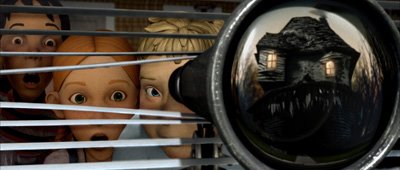
MONSTER HOUSE


Kathleen Turner arrived on the cinematic scene lusciously embodied and a few degrees warmer than any other dangerous femme fatale I'd ever seen in a movie. Her performance as Matty Walker in Body Heat seared my consciousness. Her shift into comedy as Joan Wilder in Romancing the Stone, and its sequel Jewel of the Nile, revealed an unexpected but welcome range. Her stint as host of the Oscars demonstrated charismatic professionalism. And her voice as Jessica Rabbit in Who Framed Roger Rabbit? provided one of the best lines ever: "I'm not bad. I'm just drawn that way." That voice—which time has Tallulahed—is back, this time as "house wife" Constance in Gil Kenan's Monster House, and there's no doubt she's not only bad, she's monstrous, and purposely drawn that way. More accurately, she's motion-captured that way.

Motion-capture animation, you might recall, created a successful stir with The Polar Express, graduated to the creation of Gollum and King Kong in the Peter Jackson franchises, and has now been ratcheted up one notch further with Monster House where, unlike The Polar Express, the characters are more expressive for being less tethered to the realistic. I won't say the movie is an instant classic, but, I will say the technical wizardy remains fun and appealing to kids. Which kids, however, remains the question.


I'm delighted with Kathleen Turner's participation in the project and, in my estimation, she's one of the main reasons for enjoying this Halloween-themed scary movie thrill ride. Turner became involved through Robert Zemeckis who'd cast her voice as Jessica Rabbit. Knowing of her interest in new developments, Zemeckis phoned her up and said, "Would you be interested in a new technique? You played the sexiest animated character in Roger Rabbit, now you can play the ugliest!" How could she refuse? Joining a choice ensemble of voices—Steve Buscemi, Nick Cannon, Maggie Gyllenhaal, Kevin James, Jason Lee, Catherine O'Hara, Jon Heder and Fred Willard—and introducing the perfectly-cast talents of newcomers Mitchel Musso (DJ), Sam Lerner (Chowder) and Spencer Locke (Jenny), Monster House is an impressive first feature by Kenan, plucked straight out of UCLA film school with the ink barely dry on his diploma. Monster House could probably have benefited from a little restraint—too many rides at the carnival can be exhausting after all—but no harm no foul. My eye's going to be on this guy to see how he perfects his craft in years to come. It's good to know that the Spielberg-Zemeckis tradition of feel good adventure flicks to be enjoyed at a summer matinee has found its protégé.


What kid hasn't been fascinated by a scary looking house in the neighborhood? And what adult hasn't recalled those scary remembrances of childhood? For me it was the house next door with the terrifying Foster Sisters who would charge out of their house threatening us with a broom for eating their crabapples. Monster House captures that feel perfectly because the kids really seem like kids in this movie, they talk like kids, they act like kids, even though placed in fantastic improbable situations. Or, at least, I should qualify, they're kids as adults remember themselves. Granted, all the adults in this story are ineffectual caricatures that only serve to heighten the heroic subjectivities of the three kids who—realizing the house across the street is eating people (mainly adults, and perhaps rightfully so)—bravely set out to take care of the problem armed with bottles of cough syrup, squirt guns and a few sticks of dynamite. It isn't just their imagination that transforms the barren branches of trees into grasping claws, windows into eyes, the front door into a gaping mouth, the chandelier in the front foyer into an uvula, and a Persian runner rug into a frog-like tongue. This house has a grudge and has no issues lifting itself right off its foundation to chase the kids down the street. Location, location, location, indeed! But this is perhaps the main failing of Monster House. Who is its true audience? Rated PG, perhaps more accurately PG-13, is this movie for kids, teens, or adults chaperoning them? Crude potty humor, mixed signals about inappropriate behavior, and a thematic obsession with the uncomfortable shift from childhood into puberty make it questionable that this movie is really for kids. It's probably more for grown-up kids recalling their own latch-key resiliencies.


Sam Lerner as Chowder especially rings true as the chubby sidekick who overcomes his cluelessness with sheer bumbling bravado. His facial expressions alone are worth the price of admission. His facial expressions and Kathleen Turner's voice.

What more could a grown-up kid want? Except to maybe watch it one more time in 3-D.

Cross-posted at Twitch.

Sunday, 16 July 2006

2006 SFSFF—Seventh Heaven

This is the year I've had to admit that I know very little about film; but—rather than that being distressing news—I see it as a welcome opportunity to learn and to fill in the gaps of my knowledge, film by film, auteur by auteur, genre by genre.

This weekend it's silent film at
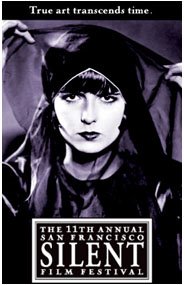
San Francisco's 11th Annual Silent Film Festival, venued at the Castro Theatre. Artistic Director Stephen Samuels was kind enough to provide me a press pass for which I am deeply grateful. I'm also informationally indebted to Jonathan Marlow for his erudite overview for The Greencine Daily, Johnny Ray Huston's recommendations for the San Francisco Bay Guardian, and—though David Jeffers of SIFFBlog admits it's a daunting task writing about silent classics that have been the subject of books, college courses and even organized fan clubs—he nonetheless provides insightful spins on Seventh Heaven, Sparrows, Pandora's Box, The Unholy Three, and Show People (with more to follow, no doubt). Anne M. Hockens is helping him out over at SIFFBlog with her own takes on why silent film matters and Seventh Heaven. And—as if that isn't enough to chew on—the program guide for the festival is a rich collection of well-written essays by David Kiehn, Margarita Landazuri, Aimee Pavy, Laura Horak, Christel Schmidt, Shari Kizirian, Stacey Wisnia, Anna Avrekh, Richard Hildreth, and Scott Brogan. So there's really not much need for me to comment on the films themselves other than for shooting from the hip emotionally and I'll focus instead on the on-stage appearances, of which the festival programmers have provided plenty.

Friday's opening night feature was a brand new print of Frank Borzage's Seventh Heaven with Janet Gaynor and Charles Farrell. Clark Wilson provided dynamic accompaniment on the Castro's Mighty Wurlitzer and Janet Gaynor's son, Robin Adrian, delivered a heartfelt centenary tribute to his mother.

"Its syrupy melodrama and creaking sentimentality can still bring tears to your eyes," Jonathan Marlow cautions and that's exactly what happened. I found myself crying—not for anything necessarily sad on the screen—but for the hopefulness of love and the dream that it can even exist in a world too cynical to grant it credence or—as David Jeffers phrases it—the film's "rapturous and poetic fulfillment of young love." Gaynor—who, incidentally, was once an usherette at the Castro Theatre—won the very first Best Actress Oscar for her heartwrenching portrayal of Diane, and Charles Farrell as Chico was so damn handsome you could completely understand why audiences used to go to movies to dream. "What makes the film great," Anne Hockens pinpoints, "is the change wrought in Diane by the redemptive power of love." She adds, "Isn't it amazing that a love story created about 80 years ago can still profoundly move a modern audience?" That's exactly what I felt. I guess, when all is said and done, we still go to movies to dream and are enraptured when movies are so finely crafted that they allow us to dream.

Margarita Landazuri, writing for the program guide, identifies Janet Gaynor and Charles Farrell as "one of the great romantic teams in movie history" whose first film together "is the transcendent film romance of the silent era, and is also the first of three films starring Gaynor and Farrell directed by Frank Borzage. It established him as a director whose films focused on love as a spiritual force tested by hardship, and the transformative power of faith—which critic Andrew Sarris called 'a genuine concern with the wondrous inner life of lovers in the midst of adversity.' "

"Co-workers claimed that Borzage would weep while directing a sad scene," Landazuri continues, "and in a 1933 interview he talked about directing the actors to draw the audience into their emotions: 'Make the audience sentimental instead of the player. Make the audience act.' " That is the achievement I felt watching Seventh Heaven Friday night at the Castro. Emotion poured out of me into the screen. I wasn't passive in the slightest and neither was anyone else around me. We were all collectively participating in emotions summoned up from within us and, as Hockens noted, many were sobbing while applauding.

Gaynor's son, Robin Adrian, thanked the festival for inviting him. "As I'm sure you know," he said, "I was not born until after the end of her silent movie career and really her talkie career so all I can say are a few words about what she was like as a mother and it's kind of hard for me to believe that it's been a hundred years since her birth.


"She didn't really consider herself a celebrity even though she and my father—the designer Adrian—were considered celebrities. Both of them were extremely down-to-earth people and, as an example, I didn't even grow up in Beverly Hills. I grew up way out in the San Fernando Valley which is now all housing tracts. But at the time it was really the country. We had nothing north of us. It was all hills and three ranches went in about 1947 and we thought it was getting crowded. The town of Northridge, just as an example, was a block and a half long and all of its stores were on one side of the street. Certainly not a celebrity type of atmosphere.

"My mother finished her career when she married my father. She'd always been very hungry for knowledge and she felt like she had done her acting career, when it was over it was over and she went on to other things. My father being an artist, he exposed her to the art world. She got interested in painting, started that as a second career, and she said that one of her proudest moments was when she was featured in an article in American Artists magazine. She said at last she was considered a true artist, not a celebrity who painted, so she was very proud of that.

"When you see her in these movies you think of her as this poor little waif or this helpless little creature. She was not that way at all. She was actually quite a brave person. She and my father went to Africa in the late '40s. She drank blood and cow's milk with the Masai. They got out of there just before the Mau Mau uprisings where there were a lot of murders that took place. She had quite a few adventures. Then they moved down to Brazil in the middle-'50s, bought a coffee farm down there and the only way they could get there was either by flying in or by dirt road. So she certainly wasn't a pampered creature.

"My father had a rather early and untimely death and she ended up a few years later marrying a Broadway producer, Paul Gregory. They had a fantastic life together. They lived in an old refurbished farm house out there in Palm Springs. They had a great life together.

"As many of you know she was involved in a horrendous car accident right here in San Francisco. She never really fully recovered from that but, I'll tell you, she was a good sport and very upbeat until the end. The rest of it has to speak for itself. I can just tell you the Janet Gaynor who I knew as a mother and I was proud to have her as a mother."

Just before he sat down at the Wurlitzer, Clark Wilson addressed his audience to advise that the score he was going to perform would be a compiled score, utilizing the original 1927 love theme written by Erno Rapee for the film with additional light classic themes and various things that he hoped would fit this tremendous movie. He admitted that when he first saw Seventh Heaven he was bowled over by the beautiful love story on the screen between Gaynor and Farrell. He wanted to strive to get his music to fit under that. "I feel very small in trying to do this," he confessed, "but we'll do the best we can. Good Lord, it's a fabulous picture. So, as always, settle back in the perfumed twilight of this wonderful old electric pleasure dome and enjoy the feature you're about to see, the timeless and ageless Seventh Heaven."

07/19/06 ADDENDUM: Peter Nellhaus has added his perceptions to the screening of Seventh Heaven at
Coffee, Coffee & More Coffee.

Friday, 14 July 2006

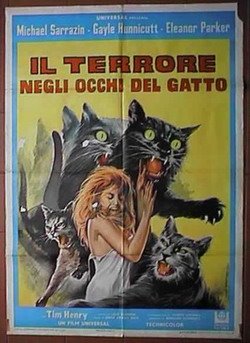
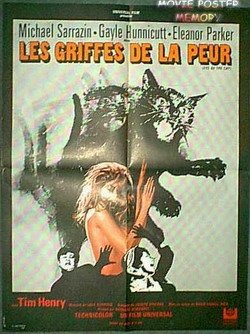
NEGLECTED HORROR—Eye of the Cat


After last week's Four Flies on Grey Velvet, Yerba Buena Center for the Arts continued its month-long tribute to "neglected horror" with David Lowell Rich's ailurophobic Eye of the Cat, whose direction—Variety noted—"often misleads" though "he does manage to get actors to speak bad lines with straight faces." Those bad lines were penned by Joseph Stefano who—to his credit—wrote the screenplay for Psycho and produced the original Outer Limits. YBCA's screening room was nearly full to capacity with a San Franciscan crowd appreciative of the kitschy allure Eye of the Cat has acquired over the decades, from its Edith Head mini-suits to its Sausalito smoke-in (which reminded me of the party skits from Rowan & Martin's Laugh-in—"I told my mother I was a latent homosexual and she said, 'Better latent than never.' "—Ka-THUMP!). I fully expected Judy Carne—that sock it to me girl—to be gyrating with flowers painted all over her body; the movie is just that mod. Can you dig it?

A surprisingly amusing blend between the psychologically perverse Alfred Hitchcock and the melodramatically perverse Douglas Sirk, this 1969 thriller starts right off with an impressive split-screen montage (eat your heart out 24!) scored by Lalo Schifrin that introduces wealthy befurred Aunt Danny (Eleanor Parker) on her way to the beauty parlor with diamond bracelets on her wrist and oxygen tank in hand. Aunt Danny suffers from debilitating emphysema which does not deter her from allowing dozens of cats to take dominion of her Pacific Heights mansion. One of them sneaks into her limousine and goes with her to the beauty parlor where, underneath the hair dryer, Aunt Danny nearly dies of a coughing attack (possibly because her hairdresser is Mark Herron, Judy Garland's fourth husband; don't blink or you'll miss his cameo). Aunt Danny's delicate condition inspires her beautician Kassia (Gayle Hunnicutt)—to whom Aunt Danny has confided one too many biographical details—to conjure up a plan on how to secure Aunt Danny's fortune when she dies. It's either that or all that money will be left to those yowling cats. Aware that Aunt Danny is pining over her missing nephew Wiley (Michael Sarrazin)—for whom she incestuously longs and for whom she would gladly change her will if Wiley would only come and sit at her bedside—Kassia tracks Wiley down and engages his cooperation in plotting Aunt Danny's demise in exchange for a split of the profits. Sarrazin, the star (you might recall) of They Shoot Horses, Don't They? (another 1969 vehicle) makes you question if they shouldn't actually shoot actors to put audiences out of their misery.

By contrast, Tim Henry—in his screen debut as Wiley's younger brother Luke—steals the show with an erotically underplayed performance. At the time of the film's release Henry was the only one who got anything close to a decent review, probably because with his shirt off and his back shiny with sweat he came thrillingly close to being indecent. It's a pity that in his prime his career didn't quite take off and that he ended up in the Battleship Galactica mini-series and, most recently, the fourth installment of Scary Movie. I won't hold it against him. We'll always have San Francisco in 1969 with Luke bare-chested in the conservatory.


I commend YBCA on securing a pristine print of Eye of the Cat. Not a single scratch (no pun intended) and only about two pops. Amazing. It made me wonder if its pristine condition is commensurate with how many times the film was actually shown? Comparisons to Hitchcock and Sirk are apt, not only as mentioned before because of Stefano's association with Psycho, but as interestingly pointed out by an IMDb member: "The cinematographer on the film was Russell Metty who photographed lots of Douglas Sirk movies and you can certainly see his style. The main set of the movie, the foyer of a large home with a winding staircase, is very much like the main set in Sirk's Written on the Wind and Metty uses the foyer's mirror and a vase of flowers in the same way as the earlier film. And even though ...Cat is set in 1969, it has that distinctive, slick, Alexander Golitzen/Universal Studios look."

Eleanor Parker—like Bette Davis/Joan Crawford in Whatever Happened to Baby Jane? and Olivia de Havilland in Lady In A Cage—rolls up in her wheelchair far behind in Eye of the Cat, not decrepit enough to be amusing, and just plain silly in her affections for Wylie whose thigh she suggestively slaps with splayed eager fingers when he finally does come to sit at her bedside.

But all these years later it doesn't really matter, does it? The gorgeous San Francisco locations around Lafayette Park, the sojourn across the Golden Gate Bridge to Sausalito, the big hair, the cats, and the bitchy cat fights provided for an evening's fun. I'm really glad I got to see this "highly entertaining obscurity."

Cross-posted on Twitch.

Wednesday, 12 July 2006

THE QUIET—The Evening Class Interview With Elisha Cuthbert


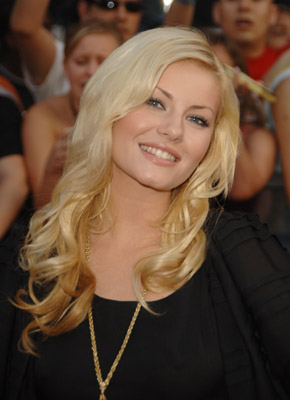
Elisha Cuthbert's room at San Francisco's Ritz Carlton had a western exposure so we sat down in late afternoon warmth to have a chat. Her beauty was unnerving, all the more so for being so natural. I couldn't stop thinking about how Elisha has the dubious honor of teaching Paris Hilton how to drink whiskey.


* * *

Michael Guillén: Elisha, a few years back every Sunday night I used to sit down and watch my favorite t.v. show, which was 24, and I would just yell . . . .

Elisha Cuthbert: At me?

MG: . . . at your character Kim Bauer for making such horrible decisions.

Elisha: [Smiling.] Right.

MG: So I'm happy that in real life you've been making great decisions with your career, the movies that you've been choosing—The Girl Next Door, the remake of The House of Wax, and now Jamie Babbit's The Quiet. The Quiet is some of your finest acting to date and the camera loves you. [She laughs.] Congratulations!

EC: Thank you!

MG: Could you describe your character Nina Deer in The Quiet?

EC: Where to begin? Well, she's 17, and Nina is going through not only adolescence during this film but also some really difficult times in her life, dealing with her father and him sexually abusing her. It's a very deep and intricate role that requires her to be one way with her friends and one way at home and to find a balance between them. She's dealing with some rough things in her life. Not just adolescence. Adolescence is rough and this is tenfold. So that alone is quite a lot. But then at the end Nina sort of discovers herself, luckily through the character of Dot [Camilla Belle] who comes to live with her. Nina thinks that she can talk to Dot and I don't think Nina would ever have that opportunity with anyone else. So Dot helps facilitate the transformation and change in my character, which is so great.

MG: I know you don't like to play roles where you're a victim. Do you consider your character in The Quiet to be a victim?

EC: Yeah, I do. But at the same time I don't think she's aware of it, which is the beauty; but, I think she's aware that it's wrong but still isn't quite sure and still is very much in love with her father and I think from a young age was just brought up that way and in this environment and doesn't know any different. But you know that she's ashamed of it because she goes to school and she hides the fact. That all makes sense for the typical situation. Nina had to be vulnerable at times, which was hard for me, that's why this has been the most difficult film for me to date because I just had such a hard time doing that. Everything about Nina was wrong to me. I think that's why I took on the role. I wanted the challenge and anything that scares me is appealing. I went for it but at the same time there were moments on the set—one moment in particular where I was filming with Martin Donovan and we were shooting some of the bedroom scene stuff—I just had to take off and go into the set bathroom to cry and bawl, because I wanted to punch him. I wanted to be sick, ill really, because that's so not me and—of course I'm playing a character—but you can't help but get emotionally involved sometimes and this was the first instance where it really affected me beyond the action/cut that was hard.

MG: How did you become involved with this project? I know that—not only are you an actor—but you're also an associate producer; how did you become involved?


EC: I had gotten the script through my agents very early on in the process. They said, "They don't have any financing for this film but we read it and we think you might respond to it." Originally they thought of me for Dot. I got the script and I thought, "Wow! What a great movie! What a great story! It's so dark and so different from everything I've done except there's a triumph at the end, which makes it all worth it to me." I went in and I met with Jamie and I said, "Dot's great and she's dark and I can cut my hair and do it dark and get that sort of introvertedness …" and she looked at me and she said, "You're talking and you're oozing Nina to me." And I thought, "The cheerleader?!! The pretty one?! I don't want to do that. Can't you see that I'm so much more than that?" She said, "Just go back and re-read it with Nina in mind and I promise you, you're going to see, it's good." I went back and I read it, I read Nina, and I thought, "You know what? She's actually more complicated than Dot is and hiding this secret life that is so painful and then also to be experiencing teenagehood." I went back to Jamie and I said, "You're right. We've got to get this movie made." We ended up getting financing in Austin through the school and filmed it in Austin. I also was involved in the casting process and things like that. A little bit more involved.

MG: Did you enjoy that?

EC: I loved it! I loved it because I think I've done enough films and worked enough and long enough to know how it all works now. When you get a little bit, you want more, you want more, you want more. It's important to stay motivated and to stay interested. I think I've got a lot more going for me than just going out and being the actor in the movie. Especially on films like this that I feel connected to. That I feel needs to be made. If I can do that, that would be great.

MG: It was Burnt Orange who produced it?

EC: Burnt Orange Productions, which was an Austin-based company that was affiliated with the University of Texas. They had a lot of money to spend and they decided to spend it on making a series of nine different independent films that would help facilitate internships for their film program.

MG: You were working with the students directly? How was that for you?

EC: They were amazing and blew me away actually. They were just as excited to be on a movie set as we were. Because this was a real movie. This wasn't mock-up or pretend or imagine we're in this situation. This was the real deal. If we mess up, we mess up and we lose money. They were amazing and so consistent and ready to put in the hours. We shot this in four weeks and we didn't have a lot of time or a lot of money, but, they made it happen, which is great.

MG: You were talking about the complex nature of the role of Nina. Between Nina and Dot, I felt the two of you carried the dark seriousness of the film, but the film is also comic and that seems to be Jamie's trademark, that blend between the comic and the dark. What was it like working with her?

EC: Great! And to have a female—I hate to say whether male, female, whatever!—but for me, it made me a lot more comfortable. The content of this character and the things she's going through are so personal and so intense and to be able to go to Jamie and say, "I need a minute to deal with this and then I'll be right back." She helped me with that. She also kept reminding me, "You're 17, you're 17, you're 17" because I do, I think, in my real life exude a certain confidence and maturity and I always had to keep reminding myself that she's 17, she's 17, she doesn't talk like that, she talks like this, and Jamie kept me focused on that too, which was great. She never got overwhelmed. She was just always very consistent. And that's what you need. You need someone that knows what they're doing. She was great.

MG: Another one of her themes that she uses a lot is popularity as a mask or defense mechanism. You didn't want to play the cheerleader, but as the popular cheerleader it was a moving role because it was a conflicted and confining persona …

EC: Exactly.

MG: … and you knew all this other stuff was going on underneath.

EC: I think she dealt with that in her first film too where there's a cheerleader but she's dealing with a lot of stuff that maybe people don't see on the surface. Most people in the world have one way they want to be perceived and then also are dealing with things in their own life. Nina is a really big example of that. And I think Jamie is fascinated by that. Jamie is very interested in topics that have to do with being uncomfortable but shouldn't be uncomfortable and putting those out there on the table. It's easier to watch these sorts of topics in a film and see it resolve than to maybe deal with it in real life.

MG: What' s your take on The Quiet's final scene where Nina and Dot are shown wading through a creek in the moonlight? What does that mean for you?


EC: Not only was it beautiful—and romantic!—but it was about her finally discovering that, "You know what? We're going to be okay" and that, as much as Nina maybe had been upset about what Dot had taken revenge on, I think she discovers at that moment, right after they bury everything and put it away, she goes, "Why did you do it?" Nina wasn't talking about her own father. Nina was asking her about Dot's father. I think at that moment she realizes that what has just happened is a good thing. Because right away you don't really sense that from Nina. I think that is a moment of clarity and the calm after the storm.

MG: I agree it's a beautiful scene. Your ensemble of co-actors, do you have anything you'd like to say? About Edie Falco…?

EC: She was very quiet making the movie. In the movie she's spacey and sometimes I thought, "Wow, that's an interesting choice" or "Oooooh, that's interesting" but the way it came across on screen just blew me away. Things I never even noticed because I was doing Nina. I was into Nina and all of a sudden I'm watching it on the screen and I cut to Edie and her eyes are rolling in the back of her head. I never saw that when we were filming. Those subtleties are so poignant in the film. I was just blown away by her. I thought she was great. Martin and I didn't do a lot of talking because, obviously, it was a little bit awkward. Camilla, and Katy Mixon who plays Michelle….

MG: Very funny.

EC: Blast! And it was her first film so I was walking her through a lot of it. I said, "Don't be worried about it. Don't get nervous. Don't freak out. Go in there and just do what you imagined and what you read the first time you opened the script and just go for it." She'd go, "Yeah, yeah, okay, okay, I got it, I got it." And then she'd go out and nail it. And I'd be like, "You nailed it! That' great!" Just crack it up. We had a good time making it.

MG: I anticipate that the film is going to do well so congratulations and thank you for your time.

EC: Thank you for your compliments. I appreciate it.

MG: You bet!

* * *

Sony Pictures Classics will be releasing The Quiet come late August. Elisha's next film—Captivity, directed by Roland Jaffe—is in post-production. In Captivity she plays Jennifer, a woman who—along with her husband—awakes to find herself held captive in a cellar. Following that thriller, you will next hear Elisha as the voice of Cleo in Cat Tale, which is currently in pre-production.

Photos courtesy of WireImage.

Cross-posted on Twitch, where Kurt has likewise posted the trailer for The Quiet.