Friday, 14 July 2006

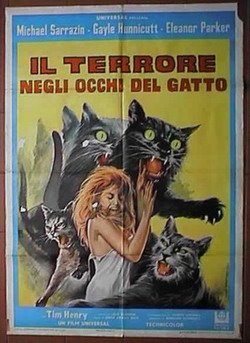
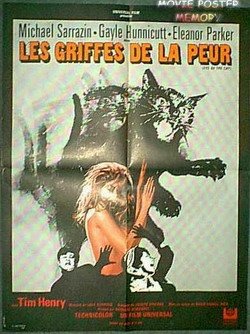
NEGLECTED HORROR—Eye of the Cat


After last week's Four Flies on Grey Velvet, Yerba Buena Center for the Arts continued its month-long tribute to "neglected horror" with David Lowell Rich's ailurophobic Eye of the Cat, whose direction—Variety noted—"often misleads" though "he does manage to get actors to speak bad lines with straight faces." Those bad lines were penned by Joseph Stefano who—to his credit—wrote the screenplay for Psycho and produced the original Outer Limits. YBCA's screening room was nearly full to capacity with a San Franciscan crowd appreciative of the kitschy allure Eye of the Cat has acquired over the decades, from its Edith Head mini-suits to its Sausalito smoke-in (which reminded me of the party skits from Rowan & Martin's Laugh-in—"I told my mother I was a latent homosexual and she said, 'Better latent than never.' "—Ka-THUMP!). I fully expected Judy Carne—that sock it to me girl—to be gyrating with flowers painted all over her body; the movie is just that mod. Can you dig it?

A surprisingly amusing blend between the psychologically perverse Alfred Hitchcock and the melodramatically perverse Douglas Sirk, this 1969 thriller starts right off with an impressive split-screen montage (eat your heart out 24!) scored by Lalo Schifrin that introduces wealthy befurred Aunt Danny (Eleanor Parker) on her way to the beauty parlor with diamond bracelets on her wrist and oxygen tank in hand. Aunt Danny suffers from debilitating emphysema which does not deter her from allowing dozens of cats to take dominion of her Pacific Heights mansion. One of them sneaks into her limousine and goes with her to the beauty parlor where, underneath the hair dryer, Aunt Danny nearly dies of a coughing attack (possibly because her hairdresser is Mark Herron, Judy Garland's fourth husband; don't blink or you'll miss his cameo). Aunt Danny's delicate condition inspires her beautician Kassia (Gayle Hunnicutt)—to whom Aunt Danny has confided one too many biographical details—to conjure up a plan on how to secure Aunt Danny's fortune when she dies. It's either that or all that money will be left to those yowling cats. Aware that Aunt Danny is pining over her missing nephew Wiley (Michael Sarrazin)—for whom she incestuously longs and for whom she would gladly change her will if Wiley would only come and sit at her bedside—Kassia tracks Wiley down and engages his cooperation in plotting Aunt Danny's demise in exchange for a split of the profits. Sarrazin, the star (you might recall) of They Shoot Horses, Don't They? (another 1969 vehicle) makes you question if they shouldn't actually shoot actors to put audiences out of their misery.

By contrast, Tim Henry—in his screen debut as Wiley's younger brother Luke—steals the show with an erotically underplayed performance. At the time of the film's release Henry was the only one who got anything close to a decent review, probably because with his shirt off and his back shiny with sweat he came thrillingly close to being indecent. It's a pity that in his prime his career didn't quite take off and that he ended up in the Battleship Galactica mini-series and, most recently, the fourth installment of Scary Movie. I won't hold it against him. We'll always have San Francisco in 1969 with Luke bare-chested in the conservatory.

I commend YBCA on securing a pristine print of Eye of the Cat. Not a single scratch (no pun intended) and only about two pops. Amazing. It made me wonder if its pristine condition is commensurate with how many times the film was actually shown? Comparisons to Hitchcock and Sirk are apt, not only as mentioned before because of Stefano's association with Psycho, but as interestingly pointed out by an IMDb member: "The cinematographer on the film was Russell Metty who photographed lots of Douglas Sirk movies and you can certainly see his style. The main set of the movie, the foyer of a large home with a winding staircase, is very much like the main set in Sirk's Written on the Wind and Metty uses the foyer's mirror and a vase of flowers in the same way as the earlier film. And even though ...Cat is set in 1969, it has that distinctive, slick, Alexander Golitzen/Universal Studios look."

Eleanor Parker—like Bette Davis/Joan Crawford in Whatever Happened to Baby Jane? and Olivia de Havilland in Lady In A Cage—rolls up in her wheelchair far behind in Eye of the Cat, not decrepit enough to be amusing, and just plain silly in her affections for Wylie whose thigh she suggestively slaps with splayed eager fingers when he finally does come to sit at her bedside.

But all these years later it doesn't really matter, does it? The gorgeous San Francisco locations around Lafayette Park, the sojourn across the Golden Gate Bridge to Sausalito, the big hair, the cats, and the bitchy cat fights provided for an evening's fun. I'm really glad I got to see this "highly entertaining obscurity."

Cross-posted on Twitch.

Wednesday, 12 July 2006

THE QUIET—The Evening Class Interview With Elisha Cuthbert


Elisha Cuthbert's room at San Francisco's Ritz Carlton had a western exposure so we sat down in late afternoon warmth to have a chat. Her beauty was unnerving, all the more so for being so natural. I couldn't stop thinking about how Elisha has the dubious honor of teaching Paris Hilton how to drink whiskey.


* * *

Michael Guillén: Elisha, a few years back every Sunday night I used to sit down and watch my favorite t.v. show, which was 24, and I would just yell . . . .

Elisha Cuthbert: At me?

MG: . . . at your character Kim Bauer for making such horrible decisions.

Elisha: [Smiling.] Right.

MG: So I'm happy that in real life you've been making great decisions with your career, the movies that you've been choosing—The Girl Next Door, the remake of The House of Wax, and now Jamie Babbit's The Quiet. The Quiet is some of your finest acting to date and the camera loves you. [She laughs.] Congratulations!

EC: Thank you!

MG: Could you describe your character Nina Deer in The Quiet?

EC: Where to begin? Well, she's 17, and Nina is going through not only adolescence during this film but also some really difficult times in her life, dealing with her father and him sexually abusing her. It's a very deep and intricate role that requires her to be one way with her friends and one way at home and to find a balance between them. She's dealing with some rough things in her life. Not just adolescence. Adolescence is rough and this is tenfold. So that alone is quite a lot. But then at the end Nina sort of discovers herself, luckily through the character of Dot [Camilla Belle] who comes to live with her. Nina thinks that she can talk to Dot and I don't think Nina would ever have that opportunity with anyone else. So Dot helps facilitate the transformation and change in my character, which is so great.

MG: I know you don't like to play roles where you're a victim. Do you consider your character in The Quiet to be a victim?

EC: Yeah, I do. But at the same time I don't think she's aware of it, which is the beauty; but, I think she's aware that it's wrong but still isn't quite sure and still is very much in love with her father and I think from a young age was just brought up that way and in this environment and doesn't know any different. But you know that she's ashamed of it because she goes to school and she hides the fact. That all makes sense for the typical situation. Nina had to be vulnerable at times, which was hard for me, that's why this has been the most difficult film for me to date because I just had such a hard time doing that. Everything about Nina was wrong to me. I think that's why I took on the role. I wanted the challenge and anything that scares me is appealing. I went for it but at the same time there were moments on the set—one moment in particular where I was filming with Martin Donovan and we were shooting some of the bedroom scene stuff—I just had to take off and go into the set bathroom to cry and bawl, because I wanted to punch him. I wanted to be sick, ill really, because that's so not me and—of course I'm playing a character—but you can't help but get emotionally involved sometimes and this was the first instance where it really affected me beyond the action/cut that was hard.

MG: How did you become involved with this project? I know that—not only are you an actor—but you're also an associate producer; how did you become involved?


EC: I had gotten the script through my agents very early on in the process. They said, "They don't have any financing for this film but we read it and we think you might respond to it." Originally they thought of me for Dot. I got the script and I thought, "Wow! What a great movie! What a great story! It's so dark and so different from everything I've done except there's a triumph at the end, which makes it all worth it to me." I went in and I met with Jamie and I said, "Dot's great and she's dark and I can cut my hair and do it dark and get that sort of introvertedness …" and she looked at me and she said, "You're talking and you're oozing Nina to me." And I thought, "The cheerleader?!! The pretty one?! I don't want to do that. Can't you see that I'm so much more than that?" She said, "Just go back and re-read it with Nina in mind and I promise you, you're going to see, it's good." I went back and I read it, I read Nina, and I thought, "You know what? She's actually more complicated than Dot is and hiding this secret life that is so painful and then also to be experiencing teenagehood." I went back to Jamie and I said, "You're right. We've got to get this movie made." We ended up getting financing in Austin through the school and filmed it in Austin. I also was involved in the casting process and things like that. A little bit more involved.

MG: Did you enjoy that?

EC: I loved it! I loved it because I think I've done enough films and worked enough and long enough to know how it all works now. When you get a little bit, you want more, you want more, you want more. It's important to stay motivated and to stay interested. I think I've got a lot more going for me than just going out and being the actor in the movie. Especially on films like this that I feel connected to. That I feel needs to be made. If I can do that, that would be great.

MG: It was Burnt Orange who produced it?

EC: Burnt Orange Productions, which was an Austin-based company that was affiliated with the University of Texas. They had a lot of money to spend and they decided to spend it on making a series of nine different independent films that would help facilitate internships for their film program.

MG: You were working with the students directly? How was that for you?

EC: They were amazing and blew me away actually. They were just as excited to be on a movie set as we were. Because this was a real movie. This wasn't mock-up or pretend or imagine we're in this situation. This was the real deal. If we mess up, we mess up and we lose money. They were amazing and so consistent and ready to put in the hours. We shot this in four weeks and we didn't have a lot of time or a lot of money, but, they made it happen, which is great.

MG: You were talking about the complex nature of the role of Nina. Between Nina and Dot, I felt the two of you carried the dark seriousness of the film, but the film is also comic and that seems to be Jamie's trademark, that blend between the comic and the dark. What was it like working with her?

EC: Great! And to have a female—I hate to say whether male, female, whatever!—but for me, it made me a lot more comfortable. The content of this character and the things she's going through are so personal and so intense and to be able to go to Jamie and say, "I need a minute to deal with this and then I'll be right back." She helped me with that. She also kept reminding me, "You're 17, you're 17, you're 17" because I do, I think, in my real life exude a certain confidence and maturity and I always had to keep reminding myself that she's 17, she's 17, she doesn't talk like that, she talks like this, and Jamie kept me focused on that too, which was great. She never got overwhelmed. She was just always very consistent. And that's what you need. You need someone that knows what they're doing. She was great.

MG: Another one of her themes that she uses a lot is popularity as a mask or defense mechanism. You didn't want to play the cheerleader, but as the popular cheerleader it was a moving role because it was a conflicted and confining persona …

EC: Exactly.

MG: … and you knew all this other stuff was going on underneath.

EC: I think she dealt with that in her first film too where there's a cheerleader but she's dealing with a lot of stuff that maybe people don't see on the surface. Most people in the world have one way they want to be perceived and then also are dealing with things in their own life. Nina is a really big example of that. And I think Jamie is fascinated by that. Jamie is very interested in topics that have to do with being uncomfortable but shouldn't be uncomfortable and putting those out there on the table. It's easier to watch these sorts of topics in a film and see it resolve than to maybe deal with it in real life.

MG: What' s your take on The Quiet's final scene where Nina and Dot are shown wading through a creek in the moonlight? What does that mean for you?


EC: Not only was it beautiful—and romantic!—but it was about her finally discovering that, "You know what? We're going to be okay" and that, as much as Nina maybe had been upset about what Dot had taken revenge on, I think she discovers at that moment, right after they bury everything and put it away, she goes, "Why did you do it?" Nina wasn't talking about her own father. Nina was asking her about Dot's father. I think at that moment she realizes that what has just happened is a good thing. Because right away you don't really sense that from Nina. I think that is a moment of clarity and the calm after the storm.

MG: I agree it's a beautiful scene. Your ensemble of co-actors, do you have anything you'd like to say? About Edie Falco…?

EC: She was very quiet making the movie. In the movie she's spacey and sometimes I thought, "Wow, that's an interesting choice" or "Oooooh, that's interesting" but the way it came across on screen just blew me away. Things I never even noticed because I was doing Nina. I was into Nina and all of a sudden I'm watching it on the screen and I cut to Edie and her eyes are rolling in the back of her head. I never saw that when we were filming. Those subtleties are so poignant in the film. I was just blown away by her. I thought she was great. Martin and I didn't do a lot of talking because, obviously, it was a little bit awkward. Camilla, and Katy Mixon who plays Michelle….

MG: Very funny.

EC: Blast! And it was her first film so I was walking her through a lot of it. I said, "Don't be worried about it. Don't get nervous. Don't freak out. Go in there and just do what you imagined and what you read the first time you opened the script and just go for it." She'd go, "Yeah, yeah, okay, okay, I got it, I got it." And then she'd go out and nail it. And I'd be like, "You nailed it! That' great!" Just crack it up. We had a good time making it.

MG: I anticipate that the film is going to do well so congratulations and thank you for your time.

EC: Thank you for your compliments. I appreciate it.

MG: You bet!

* * *

Sony Pictures Classics will be releasing The Quiet come late August. Elisha's next film—Captivity, directed by Roland Jaffe—is in post-production. In Captivity she plays Jennifer, a woman who—along with her husband—awakes to find herself held captive in a cellar. Following that thriller, you will next hear Elisha as the voice of Cleo in Cat Tale, which is currently in pre-production.

Photos courtesy of WireImage.

Cross-posted on Twitch, where Kurt has likewise posted the trailer for The Quiet.

Monday, 10 July 2006

CHICANO—Film/Video Series at the M.H. deYoung Museum


From July 22, 2006 to October 22, 2006, San Francisco's Mexican Museum in collaboration with the Fine Arts Museums presents Chicano—two distinct but related exhibitions of Chicano/a culture and painting as they have emerged in the wake of the Chicano movement for political and social change during the 1960s and 1970s. The exhibitions come to the M.H. deYoung Museum as part of a national, 15-city tour. San Francisco's Rene Yañez was the Curator of the Chicano Visions exhibition and consultant for Chicano Now.

Chicano Visions: American Painters on the Verge as Collected by Cheech Marin is largely based on the comedian and actor's private collection, reflecting those aspects of Chicano culture and the artists that most interest him. The exhibition brings together 26 Chicano/a artists from across the Southwest, including Californians Carlos Almaraz, Chaz Bojorquez, Diane Gamboa, Margaret Garcia, Rupert Garcia, Gronk, Carmen Lomas Garza, Ester Hernandez, Frank Romero, and Patssi Valdez.

Chicano Now: American Expressions was conceived as a way to immerse viewers in the creative ambience of Chicano urban experience. It is a multifaceted series of interactive installations by comedians, writers, video documentarians, filmmakers, painters, graphic designers, performance artists, musicians, and scholars of Mexican descent.

The de Young will also be exhibiting Chicano Encounters: Local Places and Global Communities, organized in cooperation with the Mission Cultural Center for Latino Arts in San Francisco. This exhibition supplements Chicano Visions and Chicano Now by giving special attention to the contributions of Bay Area artists. The exhibition features 55 prints and posters that place Chicano/a history in a global and local context through an engagement with other Latino cultures, hybrid identities, and international struggles that unite to form the culture and history of San Francisco's Mission District.

Starting Saturday, July 22, docent-led tours of Chicano Visions, Chicano Now and Chicano Encounters will begin at 1:30pm, Tuesday-Sunday. These tours are free for deYoung and Mexican Museum members and no reservation is required.

Of special note is that the deYoung will be open free of charge from 9:30 am to 5:00 pm. on opening day with a party beginning at noon, featuring the live music of Dr. Loco's Rockin' Jalapeño Band, La Familia Peña-Govea, the John Santos Quintet, and the high-energy dancers and percussionists of Loco Bloco. A formal program featuring Cheech Marin and local dignitaries, and an interactive mural project are just some of the other exciting activities at this special opening event. All are welcome!

There's no reason why any of you should know this, but I have a notable collection of Chicano and Latino art, including works by Patssi Valdez, Tony DeCarlo, Mario Romero, Viva Paredes, Evelyn Orantes, Joaquin Newman, Yolanda Lopez, Artemio Rodriguez, Calixto Robles and several others. My collection—which I nickname Rojo—was essentially kickstarted by Cheech Marin's example and so I am especially delighted to have the opportunity to savor his impressive collection more fully.

Long-time friend and collaborator, Tere Romo, curator with The Mexican Museum, has pulled together a film/video series to complement the exhibitions. Structured as three thematic Friday evenings over the course of the exhibitions, each program begins at 6:30 in the deYoung auditorium and is free after museum admission.

Friday, August 4, 6:30 p.m.
BEGINNINGS—The 1960s and 1970s (70 min.)

Yo Soy Chicano—Jesús Treviño, 1972, 60 min.
This is the first nationally broadcast documentary about Chicanos. Music, art, interviews and sepia-toned historical re-creations are interwoven to chart the Chicano experience from the pre-Columbian era to the civil rights activities of the 1960s and 1970s.

Remember Los Siete—Veronica Majano, work in progress, 10 min.
A preview of Majano's short experimental documentary about the seven Central American young men from the Mission District in San Francisco falsely accused of killing a white undercover police officer in 1969, which galvanized the Chicano movement in the Bay Area.

Question & Answer with Jesús Treviño (LA) and Veronica Majano (SF).

Friday, September 1, 6:30 p.m.
[MEDIA]TING THE MIRROR (81 min)

When You Think of Mexico: Images of Mexican in the Mass Media—Yolanda Lopez, with Carl Heyward, 1986, 28 min.
This video offers an artist's view of how the entertainment industry, food manufacturers, and other corporate interests create mythic Mexicans. It presents an analysis of the "good" (picturesque) Mexican and the "bad" (illegal) Mexican; and shows how symbols deliver their meaning both overtly and in a more subtle manner through an unspoken cultural context.

Cronica de un ser (Chronicle of a Being)—S.M. Peña, 1990, 7 min.
This video "samples" Licking the Greasers (1915) with contemporary video footage in its exploration of colonialism, media stereotypes and gender issues and their impact on Latino identity.

Asco—Juan Garza, 1994, 13 min.
This segment from PBS Heritage (KLRN, San Antonio) "Latino Artists: Pushing the Edge," describes the development of the 1970's Los Angeles visual arts/performance group of that name (Spanish for nausea) through interviews with its four members: Harry Gamboa, Patssi Valdez, Gronk and Willie Herrón.

Pretty Vacant—Jim Mendiola, 1996, 33 min.
The film tells the story of a Sex-Pistols-obsessed Chicana punk rocker who publishes a zine and struggles to investigate the Pistols' infamous gig at San Antonio redneck bar Randy's Rodeo. It's a sly take on adulation and identity.

Question & Answer with Yolanda Lopez (S.F.) and Jim Mendiola, LA.

Friday, October 6, 6:30 p.m.
RESISTANCE HUMOR (62 min)

Columbus on Trial—Lourdes Portillo, 1992, 18 min.
In this political satire featuring the comedy trio Culture Clash, sharp dialogue, physical comedy, and state of the art video techniques are used to dramatize a mock trial of Columbus in a present-day courtroom. With a "Spanish-by-way-of-Mexico" judge presiding, Columbus on Trial hits on the complexities of Latino identity in America while slicing into the kitschy consumer icons and buzzwords that stand for racial and ethnic identity in contemporary society.

Corn In The Front Yard—Al Lujan, 2001, 11 min.
A male nurse attends to a woman who had major plastic surgery paid for by her gay son. It also stars a hysterical Latino real estate queen who laments the loss of the neighborhood, as she herself becomes a mover and a shaker.

Why Cybraceros?—Alex Rivera, 1998, 5 min.
Why Cybraceros? is based on a promotional film produced in the late 1940's by the California Grower's Council, titled Why Braceros? Rivera uses footage from this old industrial to briefly lay out the history of the Bracero Program in the United States. At the half way point the piece takes a sharp turn as the narrator advocates a futuristic Bracero Program in which only the labor is imported to the United States.

Ozzy Goes to the Alamo—Jim Mendiola and Ruben Ortiz Torres, 2001, 5 min.
This duo claims this film to be "the world's first Chicano 3-D movie."

Lupe & JuanDi from the Block—Fulana Collective, 2003. 5:06 min.
Inspired by La Virgen de Guadalupe, San Juan Diego, and Nuestra Señora de J-Lo, this music video was created to answer burning questions, such as: What's up with these designer Virgen de Guadalupe jeans?, How come El Indio Juan Diego became a white man for his saintly Vatican image?, Is the Pope concerned about losing the Latino market?, and Are we fooled by the props G-Loop's got? Is she, is she, Lupe from the Block?

Larry Landia—Karim Scarlata, 2005, 17 min.
A wry and visually compelling story of a young Mission resident Chicano, Larry who fancies himself an eagle warrior as he grapples with love, the legacy of colonialism, the metaphysics of basketball, and the sacrifices one must make in life in order to make relationships work.

Question & Answer with Karim Scarlata, and Al Lujan (S.F.)

Friday, 7 July 2006

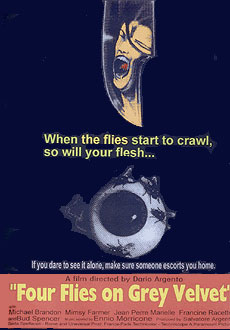
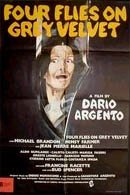
NEGLECTED HORROR—Dario Argento's Quattro mosche di velluto grigio (Four Flies on Grey Velvet)

A shout out to Brian Darr at Hell on Frisco Bay for his consummate reportage of Bay Area cinema. He helps me calendar and prioritize. His "Fear of the Dark" post alerted me to the rare screening of Dario Argento's Four Flies on Grey Velvet, the first entry in the Yerba Buena Center for the Arts "Neglected Horror" series. I'm a longtime Argento fan and—though Four Flies is admittedly not Argento's best venture—it was a screening I was not about to miss, and was not without reward.

The Terror Trap provides a serviceable plot synopsis.

Four Flies on Grey Velvet was Argento's third giallo, following L'Uccello dalle piume di cristallo (The Bird With the Crystal Plumage, 1970) and Il gatto a nove code (The Cat O' Nine Tails, 1971) (the so-called "Animal Trilogy"). One of the main components of the giallo—as pointed out by Xavier Mendek in his Senses of Cinema profile on Argento—concerns "the fate of amateur detectives who find themselves compromised by their involvement in crime and, as a result, are forced to go outside of the law to mount an unofficial investigation in order to prove their innocence." This is certainly the case with protagonist Roberto Tobias (Michael Brandon) who—angered that he is being stalked by someone in shades and overcoat—confronts his adversary in an abandoned theater and by way of scuffle inadvertently kills him. Or does he?

Howard Thompson of The New York Times was one of the first to review Four Flies. He was hardly enamored with the film, describing it as "farfetched", "banal", and "flabby." Further, he complained that "[i]n the guesswork department, Mr. Argento and his two writer colleagues simply aren't fair. All that circuitous teasing and those red herrings don't produce a shred of real evidence to nibble on. You're on your own, in pure hit-or-miss speculation."

Despite his complaints and reservations, however, Thompson had to concede that the film had its compelling, suspenseful moments, "Argento at his chilling best." Which says something about Argento's auteur proclivities, his unique sensibility, even in uneven projects. I was also struck by Thompson's exasperated query, "[W]here on earth are the police?" As if movies are tethered to practical reality, and not imaginative vision. It reminded me of Kiyoshi Kurosawa's comment following the SF International screening of Doppelganger some years back wherein Kurosawa reminded his audience that his movie was an alternate reality where there were no police and a doppelganger could get away with murder. Perhaps since 1972—when Thompson caught Four Flies in distribution—audiences and critics have acquired a better grasp on the aesthetic strengths of alterity? Because I would argue it is exactly Argento's artificiality that proves thrilling even when the plot proves silly. Who needs plot when you have beautifully-staged abstractions that grip you in heightened anxiety, if not sublime terror?

Roger Ebert also reviewed Four Flies upon its release and likewise found little to recommend it other than the presence of Mimsy Farmer, "who has the best mouth since Joey Heatherton", "looks a little like Jean Seberg, has a marvelously sculptured face and deserves to get some of those Mia Farrow roles." Like Thompson, Ebert protested Argento's purposeful obfuscations, stating Argento "cheats in another way: He throws in absolutely no clues, so that we're just as surprised at the ending as the hero is."

Ebert offered insight into Argento's playfulness. He wrote, "One of Hitchcock's favorite subjects has been the innocent man, wrongly accused. Four Flies on Grey Velvet does have a potentially interesting plot twist: the guilty man, wrongly accused." Finally, somewhat letting the cat out of the bag, Ebert complained, "There is only one fly in this movie." And that's true. In the opening sequence Roberto is being pestered by a mosquito, not a fly as it is usually described. (As an aside, I must mention that reading a review Ebert wrote nearly 30 years ago seems my way of wishing him well during his current health crisis.)

Ed Gonzales at Slant Magazine has, perhaps, the most insightful and appreciative commentary on Argento's body of work—Dario Argento's Dreams—which includes his synopsis of Four Flies and his astute conclusion that the film is "perhaps most remarkable for it's unusual spiritual underpinnings and Dario Argento's deft attention for sexual signifiers"; particularly the film's heightened "homocentric framework" which Gonzales skillfully explores.

In his Senses of Cinema essay, Xavier Mendik states Argento's "unconventional gender twists have repeatedly upset established definitions of cinematic taste." Author Maitland McDonagh (Broken Mirrors/Broken Minds: The Dark Dreams of Dario Argento) describes Argento's directorial perspective as "[a] remarkable view of the sexual world as some kind of nasty moebius strip."

I also strongly recommend Gary Needham's Kinoeye essay comparing Argento's Cat O' Nine Tails with Four Flies On Grey Velvet. He raises "central issues of gender dynamics and the Italian horror film's fixation with boundary transgression and breakdown" and provides salient psychological insights not only into this film, but the genre, and the director himself. Of special note is his discussion of "the perversity inherent in deviant and oppressive familial relations." The family, he writes, lies at the root of horror cinema.

It's interesting that Dave Kehr of the Chicago Reader would describe Argento as "Rome's answer to William Castle." Depicting gender as "the dread of difference", and the family unit as the root of horror, Argento's Four Flies aligns with Hitchcock's Psycho and Castle's Homicidal.

Through his use of doll-like masks, both in Four Flies and his follow-up Deep Red, Argento references the seeming innocence of childhood, revealed by memory—in the grip of Freud—to be a hazardous terrain of influential harm.

With so much having been written about Argento and Four Flies On Grey Velvet, I wanted to merely tease out what appealed to me. My favorite scene is one where Roberto is in his apartment in the dark at night. Outside the window tall trees are rustling in the wind; an "aural clue." Later, Argento would openly admit that Deep Red was his version of Antonioni's Blow-up. Four Flies prefigured that creative intent. The sound of the wind in the trees outside Roberto's apartment reminded me of the sound of the wind in the trees in the park in Blow-up, which Jennifer Macmillan (Invisible Cinema) identified as her favorite "cinephiliac moment" in the commentary section of Girish Shambu's post on the theme. It certainly was my favorite "cinephiliac" moment in this film.

Argento frequently achieves abstraction through his strategic use of silence and a sound design which Xavier Mendek describes as "radical splits between sound and image tracks." Though somewhat forced, I was intrigued by the scene where Roberto meets and hires Arrosio (Jean-Pierre Marielle), the private detective. The sound of his car's engine "drives" Roberto up the steps and into Arrosio's office.

It is the stylization of Argento's cinematic murders that compensates horror with beauty. The reflection of victim Dalia (Francine Racette) in a plunging knife blade becomes a clear, death-dealing mirror. Her head bumping down the stairs is both hilarious and exciting, again for its sheer artificiality. Argento has a keen gift for mixing the comic with the horrific.

The link between Roberto's repeated fantasies of execution by decapitation connects with the actual outcome of the film's killer. Though Robert Firsching (The Amazing World of Cult Movies) opines Roberto's "recurring nightmares of a decapitation in an Arabian town-square … give the film a bit more uncomfortable currency than it really needs", I concur with John White (10,000 Bullets) who observes Roberto's nightmares "foreshadow how justice will be delivered."

That justice is delivered in what Needham terms "the most poetic and tragic fate of an Argento assassin", i.e., "simply breathtaking." Xavier Mendak emphasizes Argento's technically innovative approach to this final scene of decapitation. He used a technologically-advanced high-speed medical camera, identified by Needham as "the Pentazet, a German camera which consumes 30,000 frames per second but when run at normal theatrical speed shows the image in a wholly different temporal register. It is not slow motion, as the image doesn't drag or shudder, but flowing."

As Argento is fond of reminding us, death has never been more beautiful.

Cross-posted at Twitch.

Tuesday, 4 July 2006

2006 FRAMELINE XXX FOLLOW-UP—Meth / Rock Bottom: Gay Men and Meth


"Recovery is a dominant narrative in our culture," Kent Jones writes for the May/June 2006 issue of Film Comment (p. 34). Though taken out of its Altmanesque context, I felt Jones' comment appropriate to underscore the two Frameline documentary entries on the methamphetamine epidemic among gay males—Todd Ahlberg's Meth and Jay Corcoran's Rock Bottom: Gay Men and Meth.

Introducing Ahlberg's documentary, Frameline's Associate Director Steve Jenkins asserted that, rather than duplicative programming, the two documentaries engage in dialogue. I would agree. Though both are testimonial docs, their combination provides a broader sampling of voices and perspectives on this pressing health issue. As novelist William Goyen might put it: "Had I a hundred mouths, I would tell a hundred stories." Whatever spin you might put on it, or whatever ethical stance you might take on the subject, there's no question that when all is said and done hundreds of voices will be necessary to envoice this season of fire. I'm respectful of both directors' efforts to offer some of the first.

During her keynote address at Frameline's Persistent Vision Conference, B. Ruby Rich noted that—if festivals can be used to reflect the predominant themes of any given year—this year's theme might be gay males and methamphetamine use; a sad and unfortunate fact. It is still a divisive subject and, though some consensus has been reached about the havoc meth use has wreaked among individuals and—by extension—the community, what's do be done about it is still very much a personal issue and up for debate. It reminds me of the arguments around the closing of the bath houses during the AIDS pandemic. When Jenkins noted that the screening of Meth was co-presented by The Stonewall Project—which through its website tweaker.org advocates harm reduction strategies—the concept of harm reduction was applauded. This signals conflicted attitudes within the community about how to best resolve or ameliorate the volatile issues surrounding "tina" usage.

Of the two, I felt Rock Bottom more effectively chronicled the damage of meth on individual lives. By interviewing individuals in the hospital and individuals denying the gravity of their use shortly before their deaths, Corcoran effectively demonstrated the true danger of extended meth use. The talking heads in Meth, on the other hand, seemed to be stationed before that juncture, concerned more with whether or not to stop or ratchet down use. Whereas the self-denials evident in Rock Bottom proceeded towards deteriorating health and death, the self-denials in Meth came across as familiar and almost comical. The audience laughed whenever a user claimed he had his usage under control. This disturbed me and reminded me of an insight I gained when I saw the Jean Cocteau retrospective in Paris. One of the rooms of that exhibit was devoted to Cocteau's addiction to opium. The thrust of that display was to emphasize Cocteau's cycle of use and recovery, use and recovery, which pertains to how many men grapple with their meth use, and why harm reduction is in favor rather than complete withdrawal. A truth made all the more disturbing by anecdotes of men who go to recovery groups only to make sexual contacts and find new sources of speed.

Without question, from the benefit of distance, future historians will look back at this time—much as I look back at the '70s when it seemed there was a concerted effort to make gay males alcoholics—and recognize that when cultures marginalize individuals and damage their self-esteem, they create a breeding ground for substance abuse of one form or another. Meth has revealed the obvious. Despite decades of human rights and legislative advances, some wounds have yet to be healed.

2006 FRAMELINE XXX FOLLOW-UP—Wrestling With Angels: Playwright Tony Kushner


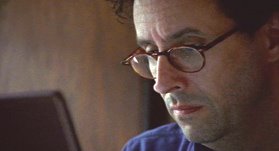
Good friend Emily Hoyer caught Frieda Lee Mock's Wrestling With Angels: Playwright Tony Kushner at its Frameline screening. I had seen the documentary at the press conference but, feeling that—due to its length—it teetered uncomfortably into hagiography, I didn't really have much to say about it. Fortunately, Emily did. "How can you go wrong with a subject like Tony Kushner?" Emily qualified, "but it still exceeded expectations." Emily has been kind enough to share her write-up with The Evening Class.


* * *

Wrestling is an extremely intimate movie—the camera is there at his wedding to Mark Harris, we see him with his bio family, we see him working with [his] composer, we see clips showing him as a flaming little sissy, we see his family's shul and his grandfather's business in Louisiana, etc. Then, of course, there are clips of his commencement address at Vassar, his speech at an anti-war protest, his appearances at a panel about the Wrestling with Zion book, his pep talk at a bank's LGBT group's meeting or Pride celebration, etc.

I have heard Kushner interviewed many times, and saw him speak at the Metropolitan Community Church once, and he always talks very articulately about his process, and what inspires him. But in the movie, you get to be there with him as he's inspired—e.g., when he is working on Brundibar with Maurice Sendak, you see clips from the Nazi propaganda film, and witness one of the few children in the film who was not murdered as she sees a performance of the Sendak-Kushner production. The movie brings you into his heart and conscience, not just his mind.

He mentions in one of his speeches "the ethical obligation not to despair" if you can possibly help it. Fortunately, instead of having Kushner talk at us about saving the world from all its woes, the movie connects us with what inspires him, and with the inspiring brilliance and conscience of his work, so we get as unmediated an experience as possible.

One other note, apropos of nothing: the movie was filmed between 09/11/01 and the November 2004 election. (One of the very last scenes is of him accompanying people in Miami as they try to vote, and helping resolve situations where people were unfairly turned away from polling places.) At the beginning of the film, Kushner was in the midst of working on Homebody / Kabul—and then all the sudden, the U.S. attacks Afghanistan. Toward the end of the film, you see Caroline, Or Change, and you see his childhood home in Louisiana, and what he used to think was the basement. The line, "nobody has a basement in Louisiana" (or something like that), is repeated many times. So watching the movie now, you see all these places and have to wonder if they still exist. Kushner must really have his finger on the pulse of something.

I am glad that this is going to be distributed in the fall, so I will get to see it again. Meanwhile, this makes me want to watch the HBO production of Angels in America again.

* * *

Though Wrestling With Angels was screened only once at Frameline, Bay Area audiences have another opportunity when it screens as part of the upcoming Jewish Film Festival at the Roda Theatre, Berkeley Repertory, on Thursday, August 3, 6:30 p.m. The documentary also won the Lena Sharpe (Audience Favorite) Award at the Seattle International.

Alternate views on the documentary include Sura Wood from The Hollywood Reporter who opines Wrestling With Angels "suffers from a crucial lack of perspective." She cautions that Mock—in getting too close to her subject—has lost her objectivity and reveals "a reluctance to cut her material." The documentary thus comes off "adulatory" and "could well have been titled Ode to Kushner." Notwithstanding, her bottom line is that Wrestling With Angels is an "entertaining doc about what it takes to be Tony Kushner."

"Because Mock is less selective," she writes, "the film drags in spots, despite the playwright's humor, conviction and abundant charm. If nothing else, this is an essay in charisma."

Variety's Robert Koehler states Mock has missed a golden opportunity to appropriately profile Kushner, providing instead "a mild, PBS-style pic more interested in Kushner's busy schedule and good citizenship than his writing."

Sunday, 2 July 2006

JAPANESE ANIMATION—Kihachirô Kawamoto


I was grateful that the East Bay Express asked Frako Loden to write up the Pacific Film Archive's two-day program of Kihachirô Kawamoto's puppet animation. With her firsthand knowledge of Japanese culture and a scholar's eye for detail, she succinctly previews the program's fare. Along with Jasper Sharp's Midnight Eye overview of Kawamoto's oeuvre and his interview with Kawamoto, as well as Miguel Romero's notes on his sabbatical encounter with Kawamoto, I felt informed and prepared.


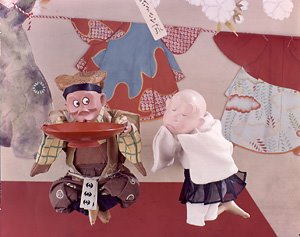
Admittedly, I only caught the first evening of Kawamoto's animation but it was enough to recognize his genius and to appreciate the beauty of his craft. His first piece—Breaking of Branches is Forbidden (Hana-Ori, 1968)—lightheartedly moralizes about the "pleasures and punishments" of drinking sake. A temple's head monk orders his young acolyte to guard a beautiful cherry blossom tree while he goes out. A samurai warrior and his servant arrive at the temple and want to feast under the branches of the cherry tree. At first, the acolyte refuses, but when he smells the sake, he succumbs to their generosity. He ends up passed out drunk dressed in women's clothing and responsible for the cherry tree's broken branch. "Here Czech mentor Jiri Trnka's influence on the early Kawamoto is most evident," Frako writes but distinguishes "that the characters' faces originate in traditional Japanese theatrical forms like kyogen—an origin shared with, say, Gimme Gimme Octopus of 1970s children's TV animation." (For those interested in pursuing Frako's references, the Japan Arts Council has an excellent webpage on noh and kyogen and Film Threat has reviewed the dvd of Gimme Gimme Octopus (Kure Kure Takora). Further, I've discovered a sampling of the inanity, plus an MP3 for those who can't get enough.)

Returning to Kawamoto, he claims the worst year of his life was the one spent raising money for Breaking of Branches Is Forbidden. Without a distributor, Kawamoto solicited his audience and exhibited the film in a rented hall.

I love the acolyte's face and bald head in this piece, so foolish and cavalier, whimsical. One of Miguel Romero's most interesting observations—among many—is about Kawamoto's puppet heads. He writes, "The most distinguishing feature of [Kawamoto's] puppets is the heads. Although smaller than his fist, the heads convey an amazing degree of psychological subtlety and depth. In demonstrating how he makes the heads, he revealed his secret. He covers the papier maché heads with kidskin. This gives the puppet's skin an exceptional smoothness and translucent quality. Since most of his puppets feature articulated eyes and mouths, the total effect, while not necessarily realistic, is very lifelike in its total effect."


Frako points out how Demon (Oni, 1972) evokes "the mysterious transformational power of mothers, especially on the threshold between life and death" and notes the story is a Japanese medieval legend Konjaku-monogatari from the same 12th-century anthology as Rashomon. Jasper Sharp states Demon's "plain black backdrops and minimalist design seems more explicitly inspired by the traditional theatrical forms of Noh and Kabuki theatre, and bunraku doll dramas." Demon concerns two brothers, both hunters, who live with their elderly mother. One day, the brothers go to the mountains to set traps for deer. Suddenly, from the top of a tree, a demon's arm reaches out and grabs the younger brother. The older brother shoots an arrow, severing the demon's arm. When they examine the arm the brothers make their "grisly discovery"—that the arm resembles their mother's.


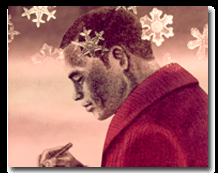
With A Poet's Life (Shinjin No Shogai, 1974), Kawamoto ventured into cut-out animation (kirigami), departing from his puppets, because he didn't think "the story was well-suited to puppet animation." But he wasn't sufficiently pleased with that venture to continue cut-out animation. After A Poet's Life, he decided not to do it anymore. "Puppets make their own story," Kawamoto explained to Midnight Eye's Jasper Sharp, "while with cut out animation the story is created by the animator."

Sharp writes: "A Poet's Life is based on a story by Kobo Abe (1924-1993), a number of whose works, such as Woman in the Dunes and The Face of Another were adapted for the screen by Hiroshi Teshigahara in the 1960s. Similar to Teshigahara's films, Kawamoto presents us with a fable which is as thought-provoking as it is incomprehensible, this time detailing an old woman working at a factory mass-producing clothing who one day mistakenly manages [to] fall asleep at the loom and weave herself into the fabric of a woolen jacket."

Winter has never been such a bitterly-cold snowflake as it is in A Poet's Life. I was moved by the film's ending: A mother rat scavenging to build a nest for her babies, inadvertently scratches the old woman's heart in the woolen jacket, which slowly becomes bloodstained with her death.


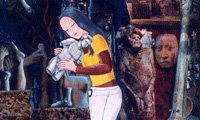
Kawamoto combined kirigami with his puppets for the surreal Travel (Tabi, 1973) wherein a young girl sets off on a physical journey, which is also an inner voyage through which she will learn all the pain and joy of life. The journey changes her completely but when she returns she is the only one who knows how she has changed. The poem in the film is by Su Tong-Po, a famous Chinese poet. Sharp found Travel's flat 2D collage style "reminiscent of Terry Gilliam's work for Monty Python, cross-referencing well-known works by surrealist artists such as Salvador Dali, Paul Delvaux and MC Escher in a deeply Freudian tale in which a young girl wanders lost through a cavernous museum space doubling as her subconscious."

But though conceding Travel was "beautiful, dreamlike work", Sharp had to ask Kawamoto directly what it meant. Kawamoto explained that in the Spring of 1968 the Soviet Union invaded Prague and killed a lot of Czech people. "The film is about the Life of Suffering," he said, "Buddha says that life is suffering and there are four basic sufferings: birth, disease, aging and dying. These are the four major sufferings in a person's life. There are a further four sufferings that Buddha spoke about. These are having to meet people you find annoying, being parted from a loved one, not getting the things you desire, and the sufferings of the mind and body. In order to get rid of those sufferings one must achieve a state of satori, or enlightenment. This is the theme of Travel. All of these elements of the eight sufferings are contained within that movie. The main character of the girl wonders if the Indian man she meets might be her lover from a former life. There's a scene where she drops the statue she is holding."


Whereas Sharp considers the 19-minute Dojoji Temple (1976) Kawamoto's most "traditionally inspired", Frako Loden describes it as a "harrowing" and "well-known tale of a girl who falls in love with a resistant pilgrim. Demonized by her unrequited feelings, she turns into a lethal serpent that encircles the huge temple bell he hides in and incinerates it, leaving him an ashy skeleton—another victim of earthly desire."

"Stylistically," Sharp furthers, "it resembles the yamato-e narrative picture scrolls of traditional Japanese art, with its watercolor backdrop of flattened compositions and non-converging parallels running to the horizon. With virtually nothing in the way of dialogue, it is one of the most lyrical and mesmeric of [Kawamoto's works]."


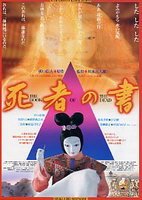
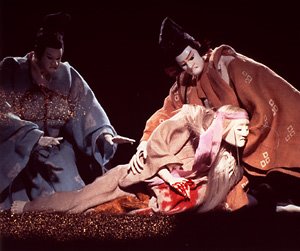
The evening's pièce de résistance, however, was The Book of the Dead [Person] (Shisha no sho, 2005), Kawamoto's second full-length feature and his magnum opus, which world premiered as part of a Special Retrospective Tribute to Kawamoto at the 40th Karlovy Vary International Film Festival, an event which likewise commemorated Kawamoto's 80th birthday. The Book of the Dead is stunningly beautiful and complex. Just to watch the fabric on Kawamoto's puppets waver in the wind is enough to make you believe in magic all over again.

Kathy Gertiz's evocative synopsis suffices: "Set during the Nara period in the mid-eighth century, when Buddhism was introduced to Japan from China, this hauntingly beautiful puppet animation intertwines two poetic stories. The first is based on a true story of a young noblewoman, Iratsume, who studies Buddhism, meticulously making copies of the amida sutra. After seeing what she believes to be a vision of the Buddha, she journeys to a temple. There she learns the story of Prince Otsu, who was executed fifty years earlier. Obsessed by a vision of a young woman, an ancestor of Iratsume, who witnessed his death, Prince Otsu's ghost haunts the temple in the belief that Iratsume is the woman of his vision. The two battle through many nights, one longing for the material world, the other striving for the spiritual. Driven to make this film because 'the world is now confused and in panic, and there is war happening for no reason,' Kawamoto expresses the Japanese Buddhist concept that the souls of those who are killed must be consoled, saying, 'I am trying to heal those innocent people who have died in recent wars.' "

Frako embroiders the theme by stating, "The elemental force of earthly desire beyond the grave is the theme that takes Kawamoto's exquisite animation beyond the fairy tale and into the realm of spiritual transformation. It seems natural that his stories come from medieval tales and Noh plays, set as they are in the enchanted spirit world of Buddhism."

For those who want a sampling of the work, Twitch provides a lovely Japanese trailer. This entry is also cross-posted on Twitch.

05/16/07 UPDATE: Dean Bowman has written an informative essay on The Book of the Dead for Midnight Eye.