My thanks to contributing writer Frako Loden for offering up cues and guidelines for this weekend's 3rd i film festival.
* * *
For me November always means 3rd i, or the San Francisco International South Asian Film Festival. Launching this Friday, November 16, at the Victoria Theatre, it spends Saturday at the Castro and touches down at the Roxie Sunday for a final full day's viewing.
By its own description, 3rd i encompasses "art-house classics to innovative and experimental visions to next-level Bollywood"—all of which it programs remarkably well for a young festival only in its fifth year. It's truly a one-stop shop for the multifarious facets of South Asian and its diaspora cinema. This year most of the films are from or about India, although notable exceptions explore events in Afghanistan, Sri Lanka and New Jersey.
Although I haven't seen the entire Saturday Castro Theatre lineup, what I have seen of it leads me to recommend it as the all-day-all-evening choice for the festival—if you have only 12 hours to spare! (A Castro pass admitting you to all of Saturday's screenings saves more than $10 over the individual ticket prices.)
 Pyaasa (Eternal Thirst)—It's worth getting up earlier than usual on Saturday to catch the 11:00 am screening of Guru Dutt's radiant 1957 masterpiece Pyaasa (Eternal Thirst). Dutt directed and starred in this romantic story of an unsuccessful poet who becomes the target of greedy media exploiters when he's thought to have killed himself, then is used all over again after he makes an appearance at his own memorial service. Dutt's poet Vijay is in love with the streets of Kolkata and their park-bench masseurs and sad-eyed pavement butterflies, but his songs are more valued for their wastepaper potential than their poetry. Vijay's rejection of renown and material security was thought to foreshadow Dutt's own renunciation of the movie world when he committed suicide before turning 40.
 Those of us who don't understand Hindi and can't appreciate the song lyrics will still recognize the visual poetry of Guru Dutt's images: a prostitute luring Vijay through the night streets, Vijay's fantasy of his first love descending a heavenly staircase and dancing with him in a knee-deep fog, and the vibrant awakenings and riots stirred by Vijay's performances.
Dosar director Rituparno Ghosh (see below) recently directed a remake of Dutt's 1962 elegy to the decadence of Kolkata feudal society, Sahib Bibi Aur Ghulam, this time starring current hot couple Shahrukh Khan and Priyanka Chopra (not showing at this festival). Although Guru Dutt was not Bengali, many of his films were set in Kolkata and his lyrical fatalism was practically a Bengali world-view.
 Loins of Punjab Presents—I haven't seen Manish Acharya's comedy yet, but judging from its description it should shake you right out of your 1950s black-and-white reverie and drop you into the comic contempo desi world of New Jersey, where contestants vie for top prize at a singing competition sponsored by a pork loin distributor. According to reviews, one of the competitors knows only two songs in Hindi: the Indian national anthem and a song from a Guru Dutt film.
 Dosar (The Companion)—A man and a woman, married but not to each other, sit at a resort outside Kolkata vaguely planning their next tryst. On their way back to the city their car has an accident, killing the woman and putting the badly injured man under the care of his resentful wife, in Bengali art film director Rituparno Ghosh's 2006 Dosar (The Companion). The director is expected to attend the festival.
Dosar is a sensitive and nonjudgmental exploration of adultery among sophisticated 21st-century Kolkata urbanites. The film's black-and-white photography, as well as emphasis on dialogue, suggest nods to earlier films about adultery and marital loneliness by Ingmar Bergman and Ghosh's Bengali mentor Satyajit Ray.
The only other film by Rituparno Ghosh I've seen is his exquisite 2003 Chokher Bali: A Passion Play, based on the Rabindranath Tagore novel and starring Aishwarya Rai as a widow in early 19th-century Bengal. Both films thrive on the lyricism and elegance of Tagore's poetry. Like Dosar, the earlier work takes time to explore the heroine's character and choices and remains in my memory as one of the most sensitive, fully-rounded and thoughtful depictions of a woman in South Asian cinema. Dosar, handicapped by a tightlipped, sullen performance by Konkona Sen Sharma, doesn't quite reach those heights but should be credited for trying. Mine is a minority opinion, by the way—Indian reviewers have uniformly called her performance "brilliant."
The film will probably draw undue attention for its sex scenes, which occur between subsidiary, even unnamed characters and don't enhance their characterization, nor are they especially integrated into the subplots. More sensuous and emotionally affecting than any of these is a scene when the wife washes her husband's hair and he gropes for her dripping hand, grunting helplessly.
It's a little puzzling why the widower has the wronged wife over to visit him simply because he's found a package of unopened condoms among his dead wife's effects and wants her to have them. They compare their unresolved marital situations, and she helps his son with his homework. Still, while the motivation for the visits is puzzling plotwise, the conversations have a realism and plausibility that increase sympathy for the wife in particular—she longs for contact and the chance to be nurturing, perhaps to her own husband on her groping path to forgiveness.
 Don—I wasn't given a screener tape for this—I rarely get to preview big-budget Bollywood films—but I can easily imagine what will take up the nearly three-hour running time of this remake (with plot twists) of the 1978 Amitabh Bachchan hit of the same title, this time featuring that current hot couple Shahrukh Khan and Priyanka Chopra as martial-arts-trained master criminals. Spectacular landscapes (Kuala Lumpur and the island of Langkawi off Malaysia). Spectacular gunplay. Spectacular song and dance. Spectacular revenge. Spectacular identity mixups. The Castro's balcony will probably open for this one—judging from earlier 3rd i presentations of Bollywood films, it could even sell out.
View From a Grain of Sand—This documentary by Meena Nanji screened at the San Francisco International Asian American Film Festival in 2006 and is happily included this weekend on the Sunday Roxie roster. I strongly recommend it for a number of reasons: its powerful profiles of Afghan women in Kabul and a refugee camp in Pakistan; its fierce nostalgia for a vanished freer era for women in Afghanistan; and its emphasis on the Revolutionary Association of the Women of Afghanistan (RAWA), the extraordinary organization fighting for women's rights and secular democracy.
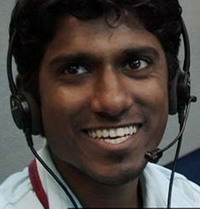
John & Jane Toll-Free—Showing Friday at the Victoria, this pseudodocumentary explores the lives of six Indian call center workers in an unnamed city (shot on location in Mumbai). As they sleep by day and work by night to service and sell to their American customers, we see that they have undergone profound changes in self-image and world outlook, helped by bizarre training sessions in "American values." The film effectively moves from relatively innocuous, even therapeutic transformations—one worker credits the call center with helping him "picturise" himself as a billionaire, while another harbors great compassion and nurturing instincts toward her unseen customers—to a final portrayal that evokes a grotesque nightmare of globalization.
Cross-published on Twitch.