I owe it to
Twitch for alerting me—as with so many other films—to Christian Volckman's
Renaissance, which won Best Picture at the
Annecy International Film Festival. Enthused by the glimpses I caught on
Twitch, I contacted the film's French publicist, Agathe Pinchon of Onyx Films, who got me in touch with Janet Kim of Miramax, the North American distributor, who arranged for me to catch a screening in San Francisco via Allied publicist Michelle Jonas. I drop all these names only because they further participated in facilitating an interview with Christian Volckman during the film's Toronto festival screening, for which I am respectfully grateful, especially since I was delinquent at securing press accreditation.
Having now seen the film, I can recommend watching
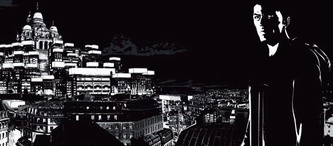
Renaissance with the caveat that it compensates for its eschewal of emotional depth by its dazzling glamorization of surfaces; akin to the sheen of skintight black latex worn by a beautiful curvaceous woman to whom you would never ever entrust your heart.
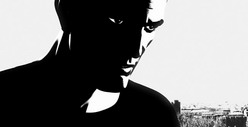
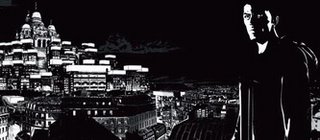
The film maintains an effective tension between opacity and translucence "exalting the imagination" [as the press notes attest] "toward the elements left in the shadow."
The storyline is spare; but, that might be just as well since you'll be prone to be distracted and fascinated with the film's mocap wizardry and its noirish affect, which
is visually thrilling. I reference film noir begrudgingly, only because it is a ready reference, and because
Renaissance commits
hamartia: aiming for the dark heart of film noir but not striking center. In
Renaissance the heart—whether dark or light—resists being seduced out of shadow and simply cannot be found; but, I accepted that early on and took this imaginative venture on its technical merits, which remain unquestionably noteworthy.
I met up with Christian Volckman at Toronto's Intercontinental. He is a lithe, handsome thirty-something who was a bit disgruntled that all the films he wanted to catch at the festival were already sold out. It surprised me that a guest director wouldn't have
carte blanche but far be it for me to understand the nature of these events. I turned him on to Best Bets and wished him the best.
* * *
Michael Guillén: Christian, congratulations on Renaissance. Striking achievement for your first feature; I'm impressed that—for as young as you are—you've brought this product out.Christian Volckman: Yeah, me too. [Chuckling.] No, it's true.
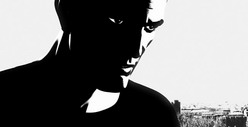
MG: What I was struck by is the look of the movie; its surfaces are dazzling. Also, it reminded me of the shamanic exercise given apprentices where they are taught to focus on the shadows of things and not where light lands in order to alter their perceptual biases. Renaissance certainly exemplifies a chiaroscuro aesthetic; all form is coaxed out of darkness.CV: Yes, it's true.
 MG: Was that your original concept? Or was that something that came up when you started working with animator Mark Miance?
CV: No. What happened was that I was touring with my first short film—
MG: That was Maaz?CV: Yeah, right, and I had worked on it for a couple of years and it was not really finished; we had like a three-minute finished product. I was touring it at the
Imagina in Monaco in France where there's a technological festival. I saw a couple of images that Mark had done in black and white and I was completely fascinated because, actually, the first film I made was in high contrast, though completely in color, but I loved the Fritz Lang movies and everything from that period. A lot of stuff that came from Expressionism out of Germany and Russia; the experience that they made in cinema for me, that was
it! So when I saw those few images, which used new technology but rendered an old kind of feeling with that shadowy look, immediately I thought it was going to be great. I met Mark and I told him his work was very interesting and then we lost touch with each other, we didn't get in touch for a long time, I didn't hear any news from him. I finished my short film and then one year later I met him again and that's when everything started. We started to work on the film.
MG: So the original concept was you wanted to do an old-style noirish type of film?CV: It didn't happen like that. It really happened when I saw the images. And for me the motion capture—which is not animation because animation is very cartoonish and can be great—but, the presence of human beings into this black and white film was for me a revelation and something that I really … there was an immediate emotion that I felt doing the film. And then Paris came along and the script started being written around Paris in this futuristic film. There's a gothic side to it. There's a
Metropolis feeling about it. That's the first emotions I had in the cinema when I was little.
MG: Paris certainly is a character in Renaissance. I love Paris. It's one of my favorite cities of the world. So for me to see this vision you had of Paris set in the not-too-distant future was enchanting, especially the glass underground mall near Notre Dame, and the car chase along the Seine was very exciting for me because it was visually accessible, something I knew and was familiar with, and yet projected forward.CV: That was the idea, yeah.
MG: You don't categorize Renaissance as animation, in fact you've said that you don't think it's either film or animation, that you think it's a new genre; how would you define that "new" genre?CV: I don't know. It's very strange technology. For me it's symbolic of what is happening to our world. You can take a character and put him into a virtual world. It's close to
The Matrix in terms of the symbolism. It's something crazy when you think about it. In the 1920s if you said in 70 years we're going to be able to capture the movement of a character and make him play a 3-D character into this computer world and you're going to be able to recreate Paris in any way you want or anything else, people would have laughed at you. And then seven years later it's happening and we can pretty much do anything we want. It's also a world that's starting to become more and more virtual and real stuff is secondary. T.V. is more important, communication on the Internet is more important, than a table and that's very strange. It's like a world of thoughts. Thoughts running around and people can grab them. You can talk to anyone on the other side of the earth. It's just a symbolic aspect of this world that we're living in transferred to an artistic media. For me, it's difficult to define this animation process because it's too new and I don't know where it's going really, y'know? Maybe someone is going to find a way to use it in a great way; I've no idea. And the obsessions around this hyperrealistic look and people are trying to emulate life….
MG: And yet it's not really photorealistic.CV: No.
MG: It's hyperrealistic, as you said, but it's not photorealistic. How would you differentiate it from rotoscoping?CV: It's just the way it's done. You create this 3-D world where whatever you want to do in this world, create a huge building, or any kind of furniture, you have to draw everything; that's one of the problems of animation, you have to draw anything that you want to see in the film. And then you find actors to incarnate your characters. You say incarnate in English?
MG: Yes, exactly.CV: And then you shoot them and then suddenly they bring life through their movements to your virtual characters that you have been creating, sculpting, in your software. Then you can frame it. That's where you have your scene that's been recorded into your computer and it's playing forever and you can play it back and forth and change angles around 360º, in any direction you can look at what's going on.
MG: The angular perspectives were intriguing, especially when you were shooting up from the underground tunnels to the people walking on the glass overhead; that fascinated me!CV: That's one of the things that is really interesting because you can frame it any way you want in any direction and you edit it at the same time. It's a little bit frustrating finally to film because you have to edit it in a 2-D world but in reality the scenes are completely recorded into your machine and you can ride around with it, you can be with your characters if you want in any way that you want. Until there, it's taking the world of human characters, bringing them into the machine, and living with them. Then after it becomes a film, you have to edit, you have to frame it, you have to add music, but at some point it's actually more free than that. I don't know how to define the genre. When I see what Zemeckis did, or what the Japanese made with this technique, it's just the beginning of it.
MG: One thing I appreciated—in contrast to some of the rotoscoped efforts that I've seen so far [A Scanner Darkly being case in point]—is that your live actors were not necessarily replicated in the film. The characters in the film are distinct personalities who don't necessarily even look like the actors portraying them. It's not like a lot of animation where the characters are purposely drawn to look like the actors or drawn to retain recognizable characteristics of the live actors. I found that refreshing, in the way unknown non-actors can be refreshing in a live feature.CV: The reference, of course, is manga films like
Ghost in the Shell and
Akira and really impressive Japanese animation; but, in those films, everybody looks the same. We wanted to go more for an expressionist kind of look.
 MG: The eyes were incredible.
CV: They're from the actors!
MG: I understand that—my nickname is Maya—so I understand you use Maya animation software—CV: You know what it means in India?
MG: Illusion, right?CV: Yeah, illusion. [Chuckles.]
MG: So you developed a Maya software that allowed you to capture the micro-movements of the eye, is that correct?CV: No, it's not a software. Actually, it's a very simple process. The actors had cameras on them with glasses that would reflect their eyes and whenever they were playing, we were recording the eye movement of the actor. And so we could reinject those movements into the eye of the virtual character afterwards.
MG: It was very powerful, very expressive.CV: Well, yeah, that's what we wanted to have. We were always frustrated by films—well,
Polar Express is a good example—because the eye movements are just really strange. You don't know where they are or what they're looking at. The belief in a character is always through his eyes. In the beginning that's what you look when you look at people; you don't look at their hands, you look at their eyes. If that wasn't right, everything was wrong, so that was one of the things we were fighting for: to make this as realistic as possible.
MG: The other achievement I thought was quite notable was how you staged and framed conversations with virtual reflections off windows. Also the transparencies in Renaissance, like the invisibility suits in the rain, were excellently executed. Can you talk a little bit about how you achieved those ghost-like effects?CV: That was also symbolic in terms of
mise en scène … how do you say that in English?
MG: What? Mise en scène?CV: Yes.
MG: We honor the French and say mise en scène.CV: Okay, so when you're thinking about the
mise en scène, for me it's like the camera is a symbolic action, it's like what you want to say in your scene and there is an unconscious level, so you have to achieve something on an unconscious level. You are trying to do something that the audience feels but doesn't know what is really going on; but, they feel that there's something. One of the things is also the reflection, the idea of the mirror and the reflection and double, y'know? Which also throws back to the high contrast in black and white. There's all this way of trying to show that the idea of eternal youth is all an illusion. So it's the reflection of the soul, which is eternal, but it's not something that we have to achieve on the body level.
MG: I thought it was interesting that you configured the idea of eternal youth as the drug of the future. I guess that is the drug that counters the fear of death even in the present. After watching the movie I was thinking the drug I imagined people taking in a war-ravaged future would be an illusion of peace; that people would be taking something that would make them believe there was peace in the world to help them cope with the fact that there really isn't any peace. But your image of eternal youth, sold through talking billboards, that reminded me a little of Blade Runner.CV: It is in reference to that.
MG: So that was an intended cinematic citation?CV: Yeah, right. In the beginning you have this citation, this publicity that's going on into the street, and you see it, and then the whole film runs through, and then you see it again in the end but it has a whole other meaning. That was one of the ideas: to deconstruct the obsession with youth. I mean, what are we all selling to ourselves? The commercials are always present everywhere but it's really the reflection of suffering.
MG: The movie is dazzlingly hypnotic with the surfaces you've created; but, what would you say is the heart of the movie? What lies behind or beneath those surfaces?CV: [Slyly smiles.] That's a trick question. [Laughs. Pauses.] There's different levels. On a philosophical level, for me, it's just the acceptance of death. That's what I wanted to talk about but that's on an unconscious level for me. It's not really in the script. It's more like a feeling, y'know? It's difficult to resume what's the core of the film.
MG: I don't mean to make you belabor it now.CV: No, it's just a complex question.
MG: It's just what I came away with. I came away with wanting to know what the heart of this film was because I was so diverted by the images and I wanted to go to the heart. And there seemed to be clues. The painting behind Dellenbach in his office of Hamlet's Ophelia floating in the water presaged Ilona eventually becoming Ophelia floating in the water; what's with that?CV: It's destiny. Every human being is creating its own world and its own suffering and its own destiny. It's not a question of whether destiny exists. It's that we are creating our own destiny by the actions that we are making. That was one of the ideas also is that Dellenbach is pretty much creating his own prison with his obsession about youth and power. He already has his future on his back but he doesn't understand it yet. That was one of the themes. But I'm very into Hinduist thinking, which is that this world is a world of action and reaction, everything is movement, nothing is … stable—stable, you say that?
MG: Yes, exactly.CV: For example, we look at a rock and we think it's not moving, but, everything is moving. Even the things that seem the hardest thing. You look at civilization and there are incredible civilizations where there's nothing left. It's really crazy. Time is consuming everything and eating up everything. It's very frightening for a human being to come into this world and say, "Okay, I'm just a changing being." You think you're young and then you think you're an adult and you want to hold onto your youth but it's going away. Maybe it's just a lesson of life.
MG: It's the ultimate lesson, I can tell you, as someone who's edging towards decrepitude here.CV: [Laughs.] But it is. I'm getting to the point, I'm 35, things have changed for me from when I was 28. But it's probably going to change of course when I'll be 40, 50. It's good because it's a learning process. That's the Hinduist kind of thinking: everything is changing. Your mind is creating your own world so you think there is an exterior, but there is not. You're creating your own happiness and your own suffering and the choices you make come back to you. Sometimes I'm very impressed when I look at the politics. For example, people who go to war. They think they can go to war and nothing's going to come back to them. It's completely unconscious action and these people must be crazy. Whenever you do something on a small level; you know it's going to come back to you. Those people do it on a great scale and they think it's not going to bother them; but, they're working their own path to hell or their own path to happiness. So there's that theme in the film. Also, the Hindus say—but, it's in every religion and the core of every religion is happiness and eternal whatever is within you and it's just there to be discovered and once you get rid of your obsession about finding happiness in this world, then you can find what is really the true happiness. But, I mean, that's just … [He suddenly becomes self-conscious.]
MG: No, no. I wish we had more time to talk about that.CV: We could all talk about that.
MG: My final question is that the movie is being billed as black and white but there is a splendid clue in the movie that is rendered in color: the young boy's drawings are done in color and I was intrigued about your decision to do that. Can you speak a little bit about that?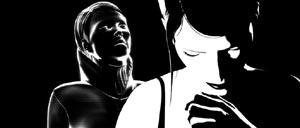
CV: There's one side of the film that is completely technological, motion capture, 3-D, very sophisticated. Suddenly this drawing is very innocent and very simple and it's just symbolically a way of talking about innocence and simplicity. One of the characters who has kept that is this Klaus character, who is this kid in the film who is stuck into eternal life, and he's still completely innocent. He was just a mirror to the whole sophisticated thing that was happening all around.
MG: And why did Ilona want to kill him? I didn't quite understand that.CV: Actually, she had a reaction to her being trapped.
MG: So it was more an immediate revenge for being held hostage?CV: If you're being held somewhere for weeks after a while…
MG: …you get mad.CV: [Laughs.] Yeah, you get mad.
MG: What are you aiming for next, Christian? Are you doing another feature next or just riding the crest of this one?CV: I don't know. I'm just asking myself questions. I have to be careful because I could ask myself too many questions and never be acting. At some point you have to go for it. I'm digesting this one. [Chuckles.] Which is a long thing because it took a long time. Then afterwards, maybe want to do something closer to the audience in terms of storytelling and being able to bring people into it faster.
MG: Well thank you very much, I appreciate your answers.CV: I appreciate your questions.
Cross-posted on
Twitch, where
Kurt has written a fine review, concurring that
Renaissance is "astounding to view but dramatically inert." He cautions: "If the talented technical team can only turn out one of these features every seven years or so, more emphasis is going to have to be put on the script next time around to make the effort less in vain."
Jason agrees in
his Twitch review: "So let's just be honest and say that the only reason to see
Renaissance are for its gorgeous visuals and groundbreaking style. Of course, the most immediate thing to notice are its almost entirely black-and-white visuals. It's amazing how the animators can communicate such visual depth with such a limited palette, but they do. As for the animation, it's as fluid as can be, utilizing motion capture to replicate real human movement, be it in the way someone walks, holds their gun, or even moves their eyes (and as we all know, the eyes are all-important in creating authentic and believable animation). It just would've been nice if the movie's four screenwriters had come up with a plot that was as original and groundbreaking as the visuals were." In the comments section to Jason's review Kurt agrees there is no "uncanny valley" effect; a fascinating term with which I was unfamiliar. Kurt followed through with
the Wikipedia definition.